
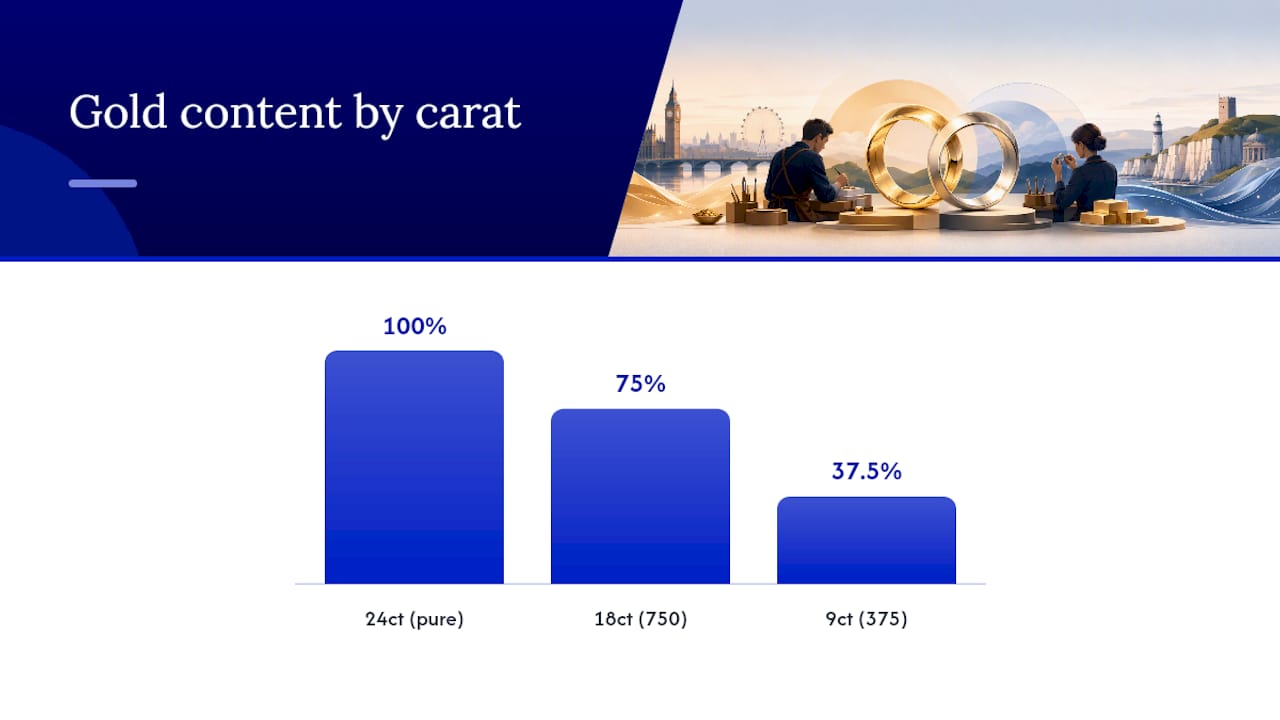
The difference boils down to gold content and what that does to the metal in practice. 9ct gold is 37.5% pure gold (stamped 375), while 18ct gold is 75% pure gold (stamped 750). That extra gold in 18ct makes it richer in colour, generally more malleable and better at shrugging off chemicals, whereas 9ct is paler, often surface-harder but more prone to brittleness, and considerably cheaper.
TL;DR:
- 18ct gold contains twice the pure gold content of 9ct, making it more malleable and resistant to tarnishing, but also significantly more expensive.
- Hallmark verification with a fineness mark and assay office mark is essential to ensure the gold’s authenticity and to avoid misleading descriptions like “gold plated.”
- 9ct gold’s higher surface hardness can resist scratches better initially, but its alloy mix often makes it more brittle and prone to cracking under impact.
- The color difference is notable: 18ct gold has a warmer, richer hue, while 9ct appears paler due to lower gold content and different alloy compositions.
- Price differences are driven primarily by gold content, but design complexity and stone setting often influence the final cost more than carat alone.
Table of Contents
- What is the difference between 9ct and 18ct gold?
- Metal content and hallmarks: what carat actually means
- Colour and appearance: why 18ct looks warmer
- Is 18ct gold better for durability, or is that a myth?
- How much more does 18ct gold cost than 9ct?
- How can you tell if gold is 9ct or 18ct?
- Which is better, 9ct or 18ct, for your situation?
- Why buying hallmarked, inspected gold matters
- What the 9ct vs 18ct debate gets wrong
- Sources
What is the difference between 9ct and 18ct gold?
If you only remember one thing from this article, remember this: carat tells you how much actual gold is in the metal, and everything else (colour, price, how it wears) flows from that one number.
- Gold content: 9ct = 37.5% gold (375 stamp); 18ct = 75% gold (750 stamp).
- Price: 18ct typically costs more per gram because it contains a higher proportion of pure gold.
- Best uses: 9ct suits fashion pieces and everyday budget buys; 18ct suits engagement rings, wedding bands, and heirloom pieces meant to last decades.
- Hallmark check: Always look for the fineness number (375 or 750) alongside an assay office mark before you hand over any money.
Rule of thumb: if a piece is going on your finger every single day for the next thirty years, lean 18ct. If it’s a trend piece you’ll wear for a season or two, 9ct does the job for far less outlay.
Metal content and hallmarks: what carat actually means
Carat measures parts of pure gold out of 24. Pure gold is 24 carat. Drop to 18 carat and you’ve got 18 parts gold to 6 parts other metal, which works out at 75% gold. Drop further to 9 carat and it’s 9 parts gold to 15 parts alloy, or 37.5%.
These aren’t rounded estimates. The UK works to strict millesimal fineness numbers, and 9ct gold carries a fineness mark of 375 while 18ct carries 750, meaning the item contains at least that percentage of pure gold by weight.
Statistic to note: any gold item sold in the UK weighing over 1 gram must, by law, be independently tested and stamped by one of the UK’s assay offices before it can legally be described as gold.
A genuine UK hallmark isn’t just the fineness number. It’s a small cluster of marks that together tell a story:
- Sponsor’s mark: identifies the maker or importer who submitted the piece for testing.
- Fineness mark: the number (375, 585, 750, 916 or 999) showing the gold percentage.
- Assay office mark: confirms which of the assay offices (London, Birmingham, Sheffield or Edinburgh) tested and verified it.
Watch out for wording like “gold plated”, “bonded gold” or “rolled gold” on listings. These describe a thin gold layer over a base metal, not solid gold, and UK guidance sets specific rules for how sellers must label them so you’re not misled into thinking you’re buying solid 9ct or 18ct. If a listing is vague about which it is, that vagueness is the warning sign, not an oversight.
Colour and appearance: why 18ct looks warmer
More gold means more colour. 18ct’s higher gold content gives it that deep, warm, almost buttery yellow that photographs so well on a wedding band. 9ct, with less than half the gold, comes out paler and slightly more muted, because the alloy metals dominate more of the mix.
What those alloy metals are matters just as much as how much gold is present. Copper pushes the tone rosier (think rose gold). Silver and palladium push it whiter and cooler. Nickel used to be common in white gold but is increasingly avoided due to sensitivity concerns.
Because the alloy recipe shifts depending on whether you’re buying yellow, white or rose gold, two rings of the same carat can still look noticeably different depending on which metals were used to make up the remaining percentage.
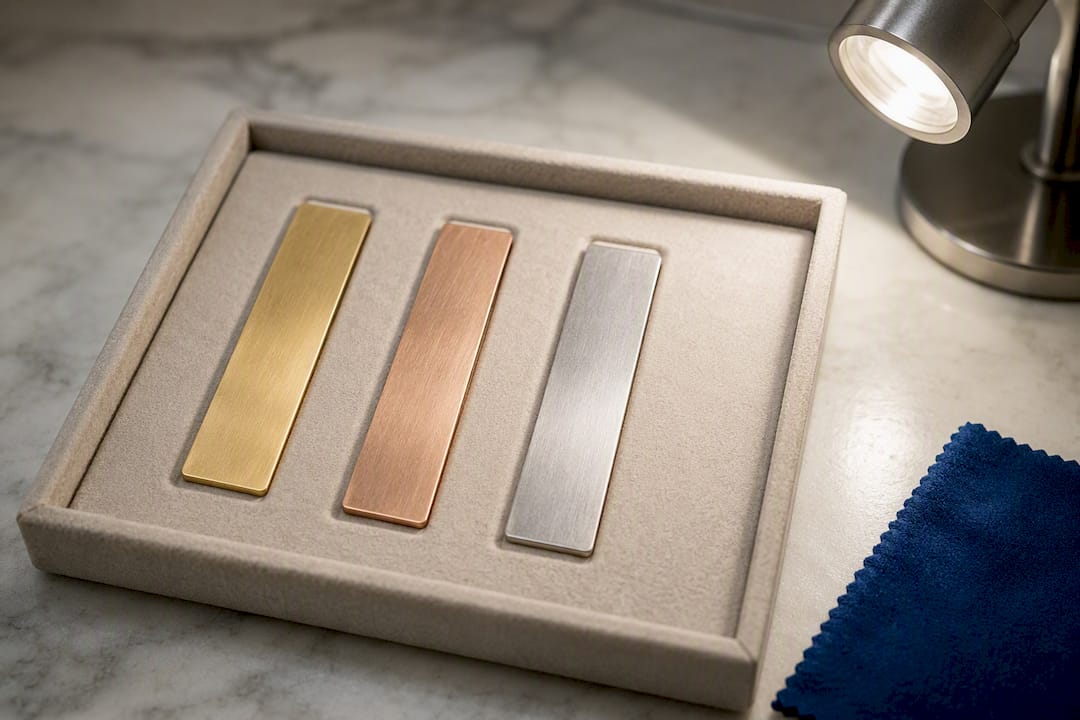
If you’re pairing a ring with certain stones or your own skin tone, this is worth thinking through before you buy rather than after. Cooler skin tones often suit the whiter alloys, while warmer skin tones tend to sit better against the richer yellow of higher-carat pieces. A jeweller who lets you try pieces against your hand in daylight, not just under shop lighting, is doing you a favour.
Is 18ct gold better for durability, or is that a myth?
Not exactly, and this is where most buying guides oversimplify things. Hardness and brittleness are two different properties, and carat alone doesn’t decide either one.
Many 9ct alloys often score higher on surface hardness, meaning they resist surface scratching reasonably well. But that same alloy mix, being heavier on base metals like copper and zinc, can make the metal more brittle. Under a sharp knock rather than a scrape, 9ct is more prone to micro-fractures or even cracking, whereas 18ct’s greater gold content generally gives it more malleability, letting it flex and absorb impact rather than snap.
That said, don’t assume every 18ct piece automatically wins on hardness. Vickers hardness ranges vary considerably by alloy recipe and heat treatment, and some 18ct alloys can be just as hard, or harder, than a given 9ct mix. Carat tells you gold content, not the full engineering spec.
Chemical resistance follows a clearer pattern. Higher gold content generally means fewer base metals exposed to soap, chlorine and sweat, so 18ct tends to hold its finish and colour longer with less tarnishing. It’s also less likely to trigger skin reactions in people sensitive to nickel or other alloy metals, though anyone with a known allergy should ask what’s actually in the mix before buying either carat.
Pro Tip: For anything you plan to wear daily, ask about the shank thickness and setting style, not just the carat. A well-built 9ct ring with a solid, generously sized shank will often outlast a delicately made 18ct piece with thin, fussy detailing.
How much more does 18ct gold cost than 9ct?
18ct contains roughly double the pure gold of 9ct by weight, so the metal cost alone is materially higher, often by a wide margin depending on the day’s gold price and the piece’s overall weight.
There’s no single fixed multiplier because design complexity, brand markup, and stone content all shift the final price. A plain 18ct band and an elaborately set 9ct piece can end up priced closer together than the carat difference alone would suggest.
For diamond rings specifically, the stone frequently dominates the total cost far more than the metal does. Choosing 9ct or 18ct changes the ring’s finish, weight and long-term wear rather than being the main lever on price when a decent diamond is involved.
If you’re buying pre-owned, condition and hallmark clarity matter as much as carat when it comes to resale value. A well-kept 9ct piece with a crisp, legible hallmark can hold value better than a scuffed 18ct item with a worn or unclear stamp. Our second-hand jewellery collection is priced with exactly that condition-and-provenance logic in mind, not carat alone.
How can you tell if gold is 9ct or 18ct?
Checking a piece properly takes a couple of minutes and saves you from an expensive mistake.
- Find the fineness stamp. Look for 375 (9ct) or 750 (18ct) stamped somewhere discreet, often inside a ring band or on a clasp.
- Check for an assay office mark sitting alongside the fineness number. No assay mark on a UK-sold item over 1 gram is a red flag.
- Confirm the weight makes sense. An item that feels suspiciously light for its size may be hollow, plated, or bonded rather than solid.
- Ask for paperwork. A reputable seller should be able to produce an assay report, invoice, or condition note describing the piece’s hallmark and carat.
A stamp that’s inconsistent with the item’s weight, a seller who talks vaguely about “gold tone” or “gold plated” without confirming carat, or a missing assay mark on anything over a gram should all make you pause before buying.
If anything looks off, or you’re buying somewhere without a visible hallmark, ask for an independent assay or a professional jeweller inspection. That process usually involves acid or electronic testing plus a visual check under magnification, and it settles the question far more reliably than guesswork. For step-by-step checks before you buy, our guide on how to authenticate gold jewellery walks through what to look for, and our breakdown of assay office marks helps you match the stamp to the office that tested it.
Which is better, 9ct or 18ct, for your situation?
There’s no universal winner here, only a better fit for what you’re buying and how you’ll wear it.
- Wedding and engagement rings: 18ct is generally the stronger choice for a piece meant to last a lifetime, thanks to its richer colour and better malleability under daily knocks.
- Fashion and budget jewellery: 9ct makes far more sense when you want a good-looking piece without a heavier price tag, especially for items you’ll rotate or replace.
- Sensitive skin: favour higher gold content, or ask specifically about the alloy mix if nickel sensitivity is a concern.
- Manual or active work: think about repairability as much as hardness. Malleable metals tend to bend rather than shatter, which often makes repair easier and cheaper.
Pro Tip: Before you buy, run through this quick checklist in the shop: budget confirmed, daily wear versus occasional wear decided, gemstones (if any) matched to the metal tone, allergy history checked, and hallmark visibly present. Five questions, thirty seconds, and you’ll buy with far more confidence.
Why buying hallmarked, inspected gold matters
A hallmark is only useful if you trust who put it there and what happened before the sale. That’s the gap a lot of buyers don’t think about until something goes wrong.
The company has traded as a family-run business for over 20 years, with multiple physical stores in Kent and a national online platform. Many second-hand pieces typically go through inspection, hallmark verification and, where needed, restoration before being offered for sale.
A trustworthy seller should be able to hand you a condition report, show you a clear photograph or physical view of the hallmark, and tell you honestly what repair or restoration work a piece has had. That’s the standard worth holding any seller to, whether you’re buying online or walking into a shop. If you’re in Kent and want to see inspected pre-owned pieces in person, our Maidstone second-hand store is worth a visit, and if an existing piece needs work rather than replacing, our jewellery repairs service covers everything from hallmark-safe resizing to full restoration.
What the 9ct vs 18ct debate gets wrong
Most guides treat this as a simple hierarchy: 18ct good, 9ct compromise. That’s lazy thinking. The honest picture is that carat tells you gold content and roughly predicts colour and chemical resistance, but it does not reliably predict which ring will survive a decade of daily wear. Alloy recipe and construction quality do far more of that work than the number stamped inside the band.
Where conventional advice really falls short is treating the hallmark as a box-ticking exercise rather than the single most reliable piece of consumer protection in this market. A stamp that’s present, legible, and backed by an assay office tells you more than any seller’s description ever will. Buyers should prioritise that verification first, ahead of carat preference, ahead of price, ahead of how a piece photographs on Instagram.
If there’s one habit worth building, it’s asking to see the hallmark before you ask about anything else. Everything downstream, colour, durability, resale value, only means anything once you know the number stamped into the metal is genuine.
— James
Sources
Claims here draw on GOV.UK’s hallmarking guidance, Assay Office London’s explanation of hallmark components, and technical analysis from Jewellery Magazine on hardness versus brittleness. For a broader look at carat and value from a European trade perspective, MARANGI’s comparison of gold purities offers useful additional context.
- Gov
- What is a hallmark (Assay Office London)
- 9ct vs 18ct gold: which better withstands the daily grind? (Jewellery Magazine)