

Seven eras define what collectors call “antique”: Georgian, Regency, Victorian (with its Romantic, Grand and Aesthetic phases), Edwardian, Art Nouveau, Art Deco, and Retro/mid-century, with anything younger usually filed under “vintage” instead. The three fastest identifiers are the stone cut (rose cut versus old mine cut versus brilliant), the metal and hallmark, and the clasp or finding mechanism, because each evolved on a documented timeline.
TL;DR:
- Stone cut techniques, metal hallmarking, and clasp design evolution are the most reliable indicators for dating antique jewelry, especially before 1900.
- Genuine Georgian pieces often feature rose or old mine cuts, hand fabrication marks, and closed-back settings, and are considered rare and highly collectible.
- Victorian subperiods—Romantic, Mourning, and Aesthetic— differ significantly in motifs, gold quality, and manufacturing methods, affecting value and authenticity.
- Art Deco jewelry is characterized by geometric cuts, platinum and white gold metals, and contrasting stones, making it distinguishable from earlier curvilinear styles.
- Authenticating period jewelry requires examining hallmarks, stone cuts, construction details, and clasp types, with specialist verification essential for high-value pieces.
Table of Contents
- What actually counts as an antique jewellery era
- Georgian era (c.1714–1837): what to look for
- Regency and late-Georgian transitional pieces (c.1790s–1830s)
- Victorian era (1837–1901): Romantic, Grand and Aesthetic phases
- Edwardian and Art Nouveau (c.1890–1915): lacy platinum and organic forms
- Art Deco (c.1920–1940): geometric modernism and cutting signatures
- Retro and mid-century through later vintage (c.1935–1980s)
- How specialists date and authenticate antique jewellery: a practical toolkit
- Quick ID checklist to use when inspecting a piece
- How Blackwelljewellers authenticates and restores period pieces
- Why era authenticity matters more than age alone
- Buying, restoring or verifying a period piece with Blackwelljewellers
- Sources
What actually counts as an antique jewellery era
Right, let’s clear up the terminology before you spend an afternoon squinting at a brooch through a loupe. In the trade, “antique” generally means a piece is around 100 years old or older, “vintage” covers roughly 20 to 99 years, and “estate” just means it belonged to someone before, regardless of age, according to Fortuna’s auction learning centre. That 100-year line moves every year, obviously, which is why a piece from the 1920s is antique in 2026 but something from the 1980s still is not.
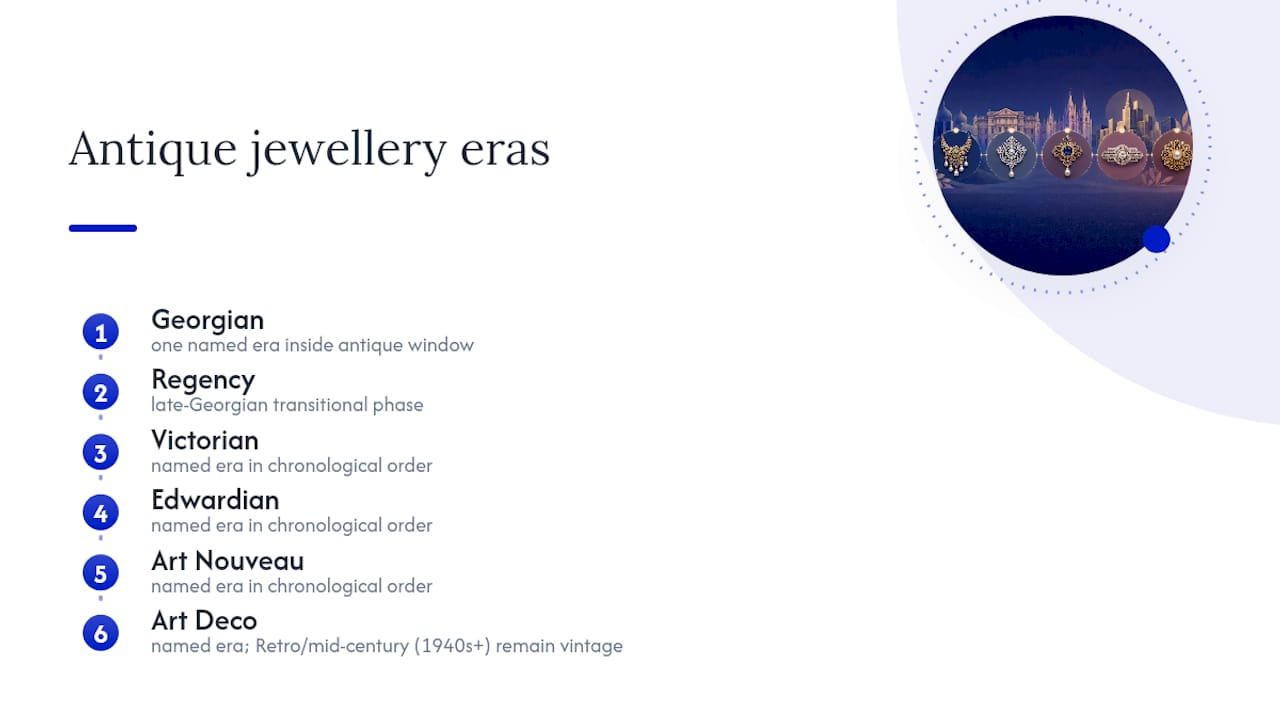
The named eras that sit inside that antique window, in order, are Georgian, Regency (a late-Georgian transitional phase), Victorian, Edwardian, Art Nouveau, and Art Deco. Retro and mid-century pieces from the 1940s onward are creeping toward antique status but currently sit more comfortably in “vintage.” Each era has its own visual grammar, and once you know what to look for, dating a piece becomes far less guesswork and far more detective work.
Georgian era (c.1714–1837): what to look for
Georgian jewellery is scarce, hand-made, and often astonishingly delicate given its age. Motifs lean natural: bows, foliage, feathers, and the peculiarly Georgian obsession with sentimental hair jewellery, where a lock of a loved one’s hair was woven into a locket or ring.
- Stone cuts: rose cuts and old mine cuts dominate, both cut by hand and both showing irregular facets under magnification.
- Settings: closed-back settings with foil backing were used to boost a stone’s sparkle in candlelight, long before electric light existed.
- Construction: look for hand-fabrication marks such as uneven solder joins and slightly asymmetric prongs, which the WhatIsThisMark antique jewellery dating guide treats as a strong indicator of pre-industrial manufacture.
Surviving Georgian pieces are rare enough that specialists often prioritise them regardless of condition.
Regency and late-Georgian transitional pieces (c.1790s–1830s)
Regency jewellery sits awkwardly between two eras, and that’s exactly the point. Neoclassical taste, driven by excavations at Pompeii and a general fascination with ancient Greece and Rome, replaced Georgian floral exuberance with cameos, urns, and classical profiles carved into shell or hardstone.
- Motifs: cameos, laurel wreaths, and Etruscan-revival gold work appear far more often than the naturalistic bows of high Georgian design.
- Contrast with Georgian opulence: Regency pieces tend toward restraint. Fewer gemstones, more emphasis on carved detail and fine goldsmithing.
- Dating caution: because this period bridges two named eras, a piece might legitimately be called either “late Georgian” or “Regency” depending on which specific features dominate, and specialists tend to hedge rather than commit to one label.
If a seller states a firm date range for a transitional piece with total confidence, that’s worth a second look.
Victorian era (1837–1901): Romantic, Grand and Aesthetic phases
Victoria’s 64-year reign produced enough stylistic change to justify splitting it into three collectable subperiods, and lumping them together is a mistake that costs collectors money.
- Romantic period (1837–1860): sentimental symbolism, snake motifs (representing eternity), and continued hairwork jewellery. Gold was often 15ct or 18ct, worked into intricate, softly rounded designs.
- Grand or mourning period (1861–1885): triggered by Prince Albert’s death and Queen Victoria’s decades of mourning, this phase favours jet, black enamel, and onyx, alongside heavier, more architectural gold pieces.
- Aesthetic period (1885–1901): a lighter touch returns, with star and crescent motifs, diamonds set in silver-topped gold, and the first mass-produced pieces thanks to industrial manufacturing.
Industrialisation is the quiet story running underneath all three phases. Cheaper 9ct gold and silver-gold combinations became common as manufacturing scaled up, and stone cutting shifted from hand-cut old mine cuts toward more standardised old European cuts as cutting wheels improved.
Edwardian and Art Nouveau (c.1890–1915): lacy platinum and organic forms
These two eras overlap almost entirely in time but couldn’t look more different, which trips up a lot of newcomers.
- Edwardian hallmarks: platinum becomes workable and fashionable from around 1900 onward, according to Tennants Auctioneers, enabling the fine filigree, millegrain edging, and lace-like openwork that defines the style. Diamonds set in platinum, garland motifs, and bow designs are the signature look.
- Art Nouveau motifs: flowing, asymmetric lines, enamel work (especially plique-à-jour), and natural subjects like dragonflies, orchids, and women with flowing hair.
- Overlap: a piece can be genuinely Edwardian in construction (platinum, millegrain) while borrowing Art Nouveau’s organic curves. Look at the metal and setting technique first, then the motif, to work out which camp it belongs to.
Pro Tip: Check the gallery edge of a gold ring under magnification. A thin rim of whiter metal soldered onto yellow gold usually signals platinum fronting, a classic marker of the late Victorian to Edwardian transition.
Art Deco (c.1920–1940): geometric modernism and cutting signatures
Art Deco arrived as a hard reset against the soft curves of Art Nouveau, and the geometry is unmistakable once you’ve seen a few genuine pieces side by side.
- Context: the interwar decades embraced speed, machinery, and modernism, and jewellery followed suit with symmetrical, angular designs.
- Cuts and settings: calibre-cut stones (gems cut precisely to fit a specific setting shape) become common, alongside step cuts, baguettes, and the earliest widespread use of the round brilliant cut.
- Metals: platinum and white gold dominate, often combined with contrasting black onyx or vivid enamel for stark visual impact.
- Combinations: diamonds paired with sapphires, or diamonds set alongside onyx and coral, are classic Deco pairings that rarely appear in earlier eras.
For a deeper dive into spotting genuine Art Deco construction versus later reproductions, Blackwelljewellers’ guide to Art Deco jewellery walks through the details.
Retro and mid-century through later vintage (c.1935–1980s)
Retro jewellery, born during and after the Second World War, is bold where Art Deco was precise. Platinum shortages during wartime pushed designers toward large-scale yellow and rose gold pieces, often set with synthetic or stabilised stones because natural gems were harder to source.
- Retro indicators: chunky gold link bracelets, oversized cocktail rings, and a general sense of “more is more” after years of wartime austerity.
- 1950s to 1970s: formality returns in the 1950s with matched diamond sets, then loosens into mod and boho eclecticism through the 1960s and 70s.
- The antique/vintage line: because the 100-year threshold keeps moving, most Retro and mid-century pieces currently sit in “vintage” territory rather than antique, though the earliest Retro pieces from the mid-1930s are edging closer.
Interest in these later periods has grown considerably, and Blackwelljewellers has tracked which vintage jewellery styles are making a comeback among UK buyers right now.
How specialists date and authenticate antique jewellery: a practical toolkit
No single clue nails down a date on its own, and that’s the bit most online guides skip. Tennants Auctioneers make the point plainly: dating jewellery relies on an integrated assessment of design, craftsmanship, stone-cut technique and metal composition working together, because so many pieces have worn, missing, or entirely absent hallmarks. Treat every clue as a vote, not a verdict.
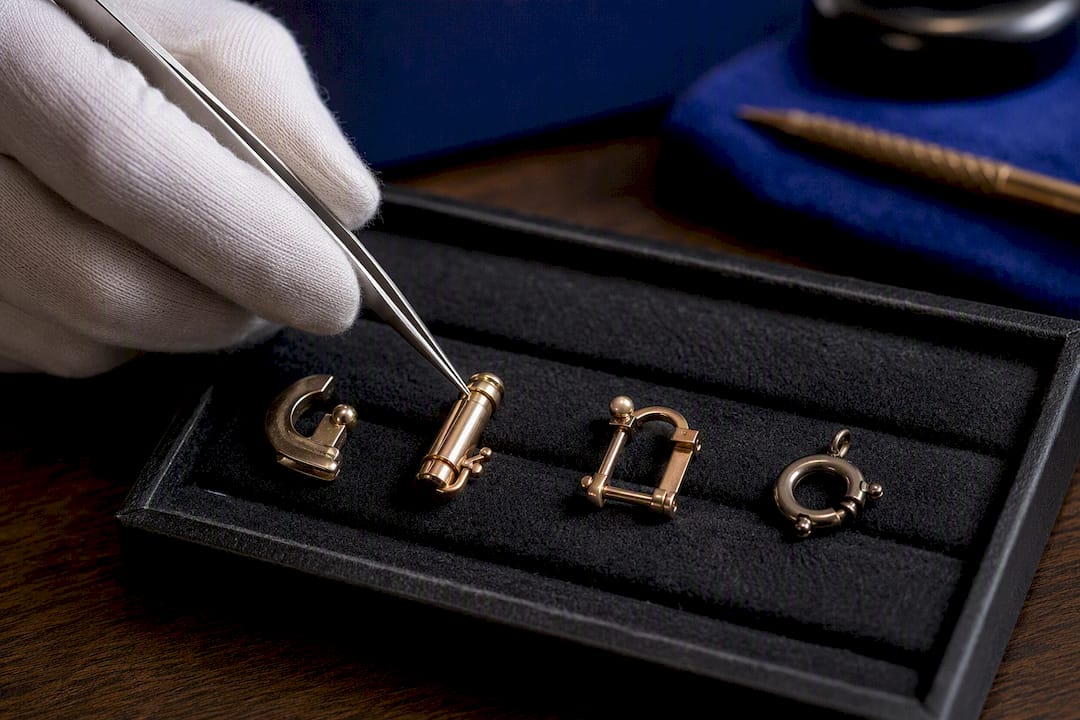
Clasps and findings give you one of the most reliable votes going, because their mechanical evolution is well documented. The WhatIsThisMark dating guide lays out the rough chronology: C-catches (a simple hook with no safety mechanism) dominate pre-1900 brooches, trombone clasps appear from the late 19th century, rollover or safety catches become standard through the early 20th century, and the modern spring ring emerges later still. A trombone clasp on a piece a seller claims is Georgian is an immediate red flag.
Metal composition tells its own story too. Platinum’s rise from around 1900 makes it a strong marker for Edwardian and later work, and British hallmarking records, kept by assay offices for centuries, can pin a piece to an exact year when the marks survive intact. Stone cuts follow a similar logic: rose cuts and old mine cuts point pre-1900, while the modern round brilliant cut only became widespread from the 1920s onward.
Statistic Callout: Fortuna’s auction specialists note that a piece described as “in the style of” a given era is explicitly not the same as a genuine period piece, and they recommend conservative attribution language over confident-sounding guesses whenever provenance is uncertain, a distinction that affects both authenticity and resale value. When a piece is significant, financially or sentimentally, a formal Gemmological appraisal or a documented condition report is worth the cost.
Quick ID checklist to use when inspecting a piece
Work through this order rather than jumping straight to the prettiest clue:
- Check for hallmarks first, even worn or partial ones, and note the metal and any maker’s marks.
- Examine the stone cuts under a loupe. Irregular facets suggest hand-cutting and an earlier date; uniform, symmetrical facets suggest later machine cutting.
- Inspect the clasp or finding mechanism and cross-reference it against known chronology.
- Look at construction quality under magnification for solder joints, tool marks, and any asymmetry consistent with hand fabrication.
- Flag red flags: a modern spring-ring clasp soldered onto an otherwise Georgian-looking piece, a replaced post on an earring, or stone cuts that don’t match the setting’s apparent age.
- Get a second opinion if two or more clues contradict each other. That contradiction is usually the difference between a genuine period piece and a later reproduction or a “marriage” of old and new parts.
For a fuller walk-through, Blackwelljewellers’ expert inspection workflow covers the same process in more depth.
How Blackwelljewellers authenticates and restores period pieces
Every piece that enters Blackwelljewellers’ pre-owned collection goes through the checks above before it ever reaches a shelf or a website listing.
- Full hallmark verification against assay office records, alongside visual inspection of stone cuts, settings, and clasp mechanisms.
- Structural authentication by in-house jewellers, not just a cosmetic clean-up.
- Restoration that repairs damage without erasing period-correct detail, with any restoration work disclosed rather than hidden.
- Guidance for buyers through Blackwelljewellers’ own guide to buying authenticated second-hand jewellery.
Every piece sold carries a verified hallmark and a documented inspection history, which matters far more than a confident-sounding description ever will.
Why era authenticity matters more than age alone
Age gets all the attention, but condition, maker, and provenance are what actually drive value. A well-preserved Edwardian ring with intact millegrain will usually outperform a battered Georgian piece with replaced findings, no matter what the date bracket says. Demand shifts too. Art Deco geometry is having a real moment right now, while some Victorian mourning jewellery, once considered morbid clutter, has found fresh collectors drawn to its craftsmanship rather than its symbolism.
Care matters as much as authentication. Keep period pieces away from harsh cleaning chemicals, store them separately to avoid scratching softer old-cut stones, and consider proper secure storage for anything genuinely valuable. A rose-cut diamond from 1820 has already survived two centuries. Don’t be the reason it doesn’t survive a third.
— James
Buying, restoring or verifying a period piece with Blackwelljewellers
Blackwelljewellers is the alternative to buying blind on an online marketplace, because every piece in the pre-owned collection has already been through the hallmark and construction checks this article just walked you through, done by in-house jewellers rather than a stock photo and a hopeful description.

Browsing the authenticated second-hand jewellery collection gets you straight to pieces that have already passed inspection, with hallmarks verified and restoration history disclosed rather than glossed over. If you already own a period piece that needs restoration without losing its original character, Blackwelljewellers’ jewellery repair service handles that work in-house, and the bespoke design service can rework a family piece into something wearable while preserving its story. Visit the Maidstone, Gravesend, or Bexleyheath stores, or browse online, and start with the second-hand collection to see what’s currently in stock.
Sources
For hallmark lookups and assay records, consult your national assay office directly rather than relying on trade guides alone. Tennants Auctioneers and the WhatIsThisMark dating guide both offer solid grounding in construction-based dating, while Fortuna’s learning centre clarifies trade terminology. When real money is on the table, a formal appraisal beats a guide every time.
- Identifying the period of jewellery | Tennants Auctioneers
- Antique Jewelry Dating Guide | WhatIsThisMark
- Antique, Vintage, or Estate Jewelry? - FORTUNA