
TL;DR:
- Gold pricing is based on the LBMA benchmark spot price, adjusted for purity, premiums, and additional costs.
- Dealer premiums vary widely depending on product type, purity, and retailer, affecting the final price.
- Always verify hallmarks, request itemized quotes, and compare multiple sources to ensure fair value.
Gold is not priced the way most people think. There is no single figure you can look up and use to compare every ring, bar, or coin on the market. What you find online is a starting point, not a final answer. The spot price, the purity of the gold, the dealer’s premium, and even the day of the week all shape what you’ll actually pay. This guide breaks down how UK gold pricing genuinely works in 2026, so whether you’re buying jewellery, investing in bullion, or selling an inherited piece, you’ll know exactly what you’re looking at and how to get real value.
Table of Contents
- How UK gold prices are set today
- Spot price vs dealer price: What affects what you pay
- How gold carat, weight and form change your price
- Finding today’s best value: Practical steps and common mistakes
- Why chasing the lowest headline gold price is often a mistake
- Explore trusted gold options with Blackwell Jewellers
- Frequently asked questions
Key Takeaways
| Point | Details |
|---|---|
| UK gold price basics | The official live price is set by the LBMA and updated for local markets like the Royal Mint. |
| Spot vs retail cost | What you pay for gold jewellery always includes dealer premiums and may be higher than the spot price. |
| Comparing offers | To find the best value, compare not just the price but also carat, weight, dealer reputation, and hidden costs. |
| Buyer tips | Always check the latest spot rate, confirm all add-on fees, and choose a reputable UK dealer. |
How UK gold prices are set today
Before you can compare any gold price intelligently, you need to understand where that number comes from. Gold is a globally traded commodity, and its base price is not set by any individual shop, bank, or government. It flows from an international mechanism most buyers never hear about.
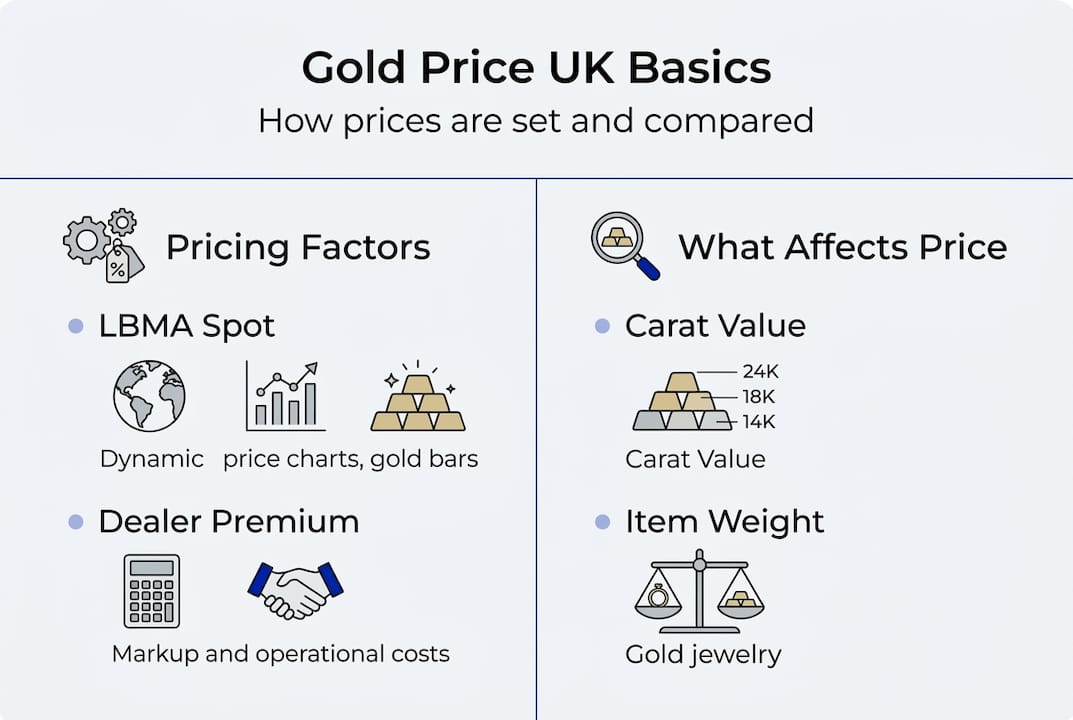
The LBMA benchmark price is the cornerstone of global gold pricing. The London Bullion Market Association runs twice-daily electronic auctions that establish the internationally recognised reference price for gold. Banks, refiners, and central banks worldwide use these figures. When any UK dealer, jeweller, or platform quotes a gold price, that number traces back to what the LBMA last fixed.
In the UK, the most visible expression of this is the Royal Mint live gold price, which currently sits at £3,484.29 per troy ounce and updates approximately every 30 seconds during trading hours. Critically, if you check over a weekend or on a bank holiday, the price you see will be frozen from the last trading session. That matters if you’re trying to assess a quote received on a Friday afternoon.
Understanding the units is equally important. Gold is priced internationally in troy ounces, which are slightly heavier than a standard ounce (a troy ounce equals 31.1 grams). Most jewellery is weighed in grams, so knowing how to convert matters. Divide the troy ounce price by 31.1 to get the price per gram. At today’s rate, that works out to roughly £112 per gram for pure 24-carat gold. You can read more about how to calculate gold worth per gram using live rates and purity adjustments.
So what exactly is the “spot price”? It’s simply the current market price for one troy ounce of pure gold, settled immediately rather than in a futures contract. Think of it as the raw ingredient cost before anything is added by retailers, designers, or distributors.
Here’s how the component parts of a UK gold quote stack up:
| Component | What it represents |
|---|---|
| Spot price | The global base price per troy ounce, set by LBMA |
| Conversion to grams | Spot ÷ 31.1 = price per gram of pure gold |
| Purity adjustment | Multiply by carat fraction (e.g., 0.75 for 18ct) |
| Dealer premium | Retailer’s operational margin added on top |
| VAT (if applicable) | Charged on jewellery; exempt on investment gold |
The spot price is the floor, not the price. Nobody sells gold at spot. Every quote you receive in the real market is spot plus something.
Key facts to keep in mind when reading any UK gold price:
- Prices are quoted in British pounds sterling, converted live from the US dollar denominated international spot rate
- Weekend prices are static and only reflect live markets again on Monday morning
- High street dealers and online platforms have different cost structures, so premiums vary significantly
- VAT is exempt on investment gold but applies to gold jewellery at the standard 20% rate
Spot price vs dealer price: What affects what you pay
Knowing the spot price is useful. But it doesn’t tell you what you’ll pay at checkout, because no single gold price applies to everyone in the UK. What you actually pay depends on spot, purity, and the dealer’s individual premium structure. All three interact differently depending on whether you’re buying a bullion bar, a sovereign coin, or a diamond-set gold necklace.
A dealer premium is the markup added above spot to cover the dealer’s costs: storage, insurance, staff, premises, marketing, and profit margin. For simple bullion products, this might be as low as 2 to 5% over spot. For elaborately designed jewellery from a luxury brand, the premium can be 300% or more. Neither is inherently wrong, but buyers need to understand what they’re paying for.
Here’s a simplified comparison to illustrate how the same underlying gold value can lead to very different end prices:
| Product type | Spot gold value | Dealer premium | Approximate final price |
|---|---|---|---|
| 1 oz gold bullion bar | £3,484 | 3 to 5% | £3,588 to £3,658 |
| 1 oz gold sovereign coin | £3,484 | 5 to 8% | £3,658 to £3,762 |
| 18ct gold bracelet (15g) | £1,282 | 80 to 150% | £2,308 to £3,205 |
| 9ct gold ring (4g) | £170 | 150 to 250% | £425 to £595 |
Beyond the basic premium, watch for these additional costs:
- Commission fees on resale or trade-in transactions
- Delivery and insurance charges, especially for bullion posted to your home
- Authentication or valuation fees at some dealers
- Card surcharges on high-value purchases
For benchmarking purposes, the LBMA spot reference is your most reliable starting point for any comparison. From there, each dealer’s premium is what varies. Knowing this, you can genuinely compare like for like.
If you’re also thinking about the selling side of this equation, understanding where to sell gold UK and how scrap gold prices UK are calculated will save you from accepting far below what your gold is worth.
Pro Tip: Always ask a dealer to separate the spot price component from their premium in any written quote. If they refuse or can’t explain it, that tells you something important about how they price.
How gold carat, weight and form change your price
Once you’ve grasped how spot prices and dealer premiums interact, there’s a third major variable: what the gold actually is. The purity of the gold and the form it takes (jewellery, coin, bar) change your cost per gram considerably.
Purity is measured in carats in the UK. Here’s what those numbers mean:
- 24 carat (999.9 fine): Pure gold. This is the standard for bullion bars and most investment coins. No alloys mixed in.
- 18 carat (750 fine): 75% pure gold, 25% other metals. Common in quality jewellery. More durable than pure gold for everyday wear.
- 9 carat (375 fine): 37.5% pure gold. The most common carat in UK high street jewellery. Affordable and hard-wearing, but significantly lower in gold content.
The price per gram changes significantly by purity. Using today’s approximate rate of £112 per gram for pure gold:
| Carat | Purity fraction | Approximate gold value per gram |
|---|---|---|
| 24ct | 99.9% | £112 |
| 18ct | 75% | £84 |
| 9ct | 37.5% | £42 |
Notice that jewellery always costs more per gram than its raw gold content would suggest. A 9ct gold ring containing £42 worth of gold might retail for £150 to £400, because you’re paying for design, craftsmanship, hallmarking, and the retailer’s overheads. This is not a scam. It’s simply the reality of manufactured goods versus raw materials.
The form of gold also matters. Bullion coins, like the Britannia or South African Krugerrand, carry a smaller premium because they are standardised, liquid, and easy to resell. Jewellery, by contrast, carries higher premiums because it involves skilled labour, design, and often cannot be resold quickly for its metal value alone.
To work out the true gold content value of any piece you own or are considering buying:
- Identify the carat (usually hallmarked on the piece)
- Weigh the item in grams using accurate scales
- Multiply the weight by the purity fraction (e.g., 0.75 for 18ct)
- Multiply that figure by the current price per gram of pure gold
This gives you the metal value. Everything above that is premium. If you’d like to work through this at home, our guide on how to value your gold at home takes you through the process step by step. For those thinking about selling rather than buying, the selling gold jewellery guide covers what dealers actually pay versus what the metal is worth.
Pro Tip: When buying second-hand gold jewellery, ask for the hallmark certificate or confirm the hallmark in person. A hallmark legally confirms the carat and protects you as a buyer under UK assay law.
Finding today’s best value: Practical steps and common mistakes
Armed with knowledge about what drives gold pricing, now it’s time to put it into practice and avoid the mistakes most buyers make.
The first step is always to get a real-time reference before you approach any dealer. Check the Royal Mint’s live bullion quote, which combines the LBMA spot rate with their current selling premium, updated live. This gives you an honest baseline. Any dealer pricing substantially above this for equivalent purity and weight deserves scrutiny.
Here are the essential steps for getting verified, comparable gold prices in the UK:
- Check the live LBMA or Royal Mint rate as your starting point, not the first dealer quote you receive
- Request itemised quotes that separate the metal value, premium, VAT, delivery, and any other charges
- Compare at least three sources including an online bullion dealer, a local jeweller, and a specialist platform
- Ask for written quotes with a validity window, especially for larger purchases
- Confirm the hallmark status of any jewellery piece before purchase
- Check seller credentials including membership of trade bodies such as the National Association of Jewellers (NAJ) or the British Jewellers’ Association (BJA)
Common mistakes buyers make include focusing exclusively on the headline price without understanding what’s included. An online dealer advertising “gold at 1% over spot” might add 5% for card processing, insurance, and delivery, taking the real premium to 6% or more. A high street jeweller with a higher sticker price might include free valuation, insurance documents, and an easy returns policy worth far more than the difference in cost.
Suspicious pricing is another red flag. If an offer is dramatically below the spot price, it often signals either misrepresented purity, a scam, or gold that cannot be resold at a fair price. Genuine dealers cannot sustainably sell gold below spot for long.
Questions to ask any gold dealer before committing:
- What is your current premium over spot for this product?
- Is VAT included in this price?
- What are your delivery and insurance charges?
- Do you offer a buyback service, and at what rate?
- Are pieces hallmarked and authenticated?
For additional gold selling tips that apply equally to buying situations, understanding the negotiation dynamics between buyers and dealers will consistently save you money.
Pro Tip: For jewellery purchases specifically, the cost per gram of gold is rarely the most important number. Focus on hallmark confirmation, structural quality, and the dealer’s aftercare before comparing metal prices.
Why chasing the lowest headline gold price is often a mistake
After 20 years of working with gold buyers and sellers across Kent, we’ve noticed a consistent pattern. The customers who focus obsessively on finding the absolute lowest price often end up with the most regrets. Not always. But often enough that it’s worth saying plainly.
The lowest advertised price can mean lower purity than stated, no hallmark verification, no returns policy, and no recourse if something is wrong. We’ve seen buyers come to us after purchasing gold jewellery online at “bargain” rates, only to discover the piece is incorrectly stamped, structurally compromised, or misrepresented in weight.
Established dealers cost slightly more for a reason. You’re paying for accurate valuation expertise, legal accountability, proper hallmarking, and the ability to walk into a shop if something isn’t right. For investment gold, a small premium to a reputable source is cheap insurance. For jewellery, it’s even more important.
This doesn’t mean ignoring price. It means treating price as one factor among several. The best place to sell jewellery is rarely the one offering the highest single quote in isolation; it’s the one offering fair value with transparency and accountability. The same principle applies when buying.
Trust is a material cost in any gold transaction. Price it accordingly.
Explore trusted gold options with Blackwell Jewellers
At Blackwell Jewellers, we bring over 20 years of hands-on experience to every gold transaction, whether you’re buying, selling, or simply curious about what your pieces are worth.

Our second-hand gold jewellery collection is rigorously inspected, hallmark-verified, and professionally restored before it reaches the shop floor or our online listings. Every piece carries a clear history and honest provenance. If you have a piece that needs attention, our jewellery repairs service handles everything from structural work to full restoration, carried out in-house by our expert team. With stores across Kent and a national online platform, transparent pricing and genuine aftercare are always within reach.
Frequently asked questions
What is today’s official gold price in the UK?
The Royal Mint’s live price is £3,484.29 per troy ounce, based on LBMA benchmarks and updated every 30 seconds during trading hours.
Is there VAT to pay when buying gold jewellery in the UK?
VAT is not charged on investment gold such as bullion bars and coins, but standard 20% VAT applies to most gold jewellery purchases.
Why does every gold dealer have a different price?
Each dealer adds a premium over the spot price to cover their overheads, commission, and profit margin, which is why quotes vary between retailers.
How can I check if a gold price is fair?
Compare the quoted price against the LBMA benchmark, then calculate the dealer’s premium as a percentage over spot and compare that figure across at least three sources.