
TL;DR:
- Selling gold jewelry in the UK remains profitable despite recent price corrections, because gold’s long-term value continues to be high. Proper preparation, accurate valuation, and choosing the right selling channel can significantly boost your final payout. Long-term demand and market stability make now an advantageous time to sell unwanted gold items.
Now is a genuinely good time to sell gold jewellery in the UK, despite a recent price correction from record highs. Gold remains one of the top-performing assets over the past 12 months, and UK sellers are sitting on historically strong values. The London Bullion Market Association (LBMA) spot price still reflects elevated gold values, meaning the window for a profitable sale is very much open. Whether you have a broken chain, a vintage brooch, or a designer ring gathering dust, the current market rewards sellers who understand their piece and choose the right channel.
Is now a good time to sell gold jewellery in the UK?
Yes, and here is why. Gold gained 33% over 12 months despite pulling back from its february all-time high. That correction is real, but it does not erase the extraordinary run gold has had. Sellers who bought or inherited jewellery years ago are still looking at returns that would make a savings account weep.
The LBMA spot price is the benchmark UK dealers use to calculate payouts. When that price is elevated, even a modest payout percentage translates to a meaningful sum. The key is knowing what you have, where to sell it, and how to prepare it properly.
How have gold prices behaved recently, and what does this mean for sellers?
Gold prices in 2026 have been on a bit of a rollercoaster. The price corrected 15.6% below the february all-time high, yet gold averaged $4,238 per troy ounce in june 2026. That is still a remarkable figure by any historical standard.
Gold’s recent correction has spooked newer investors, but longer-term holders and Asian buyers continue purchasing through the dips. The underlying demand story has not changed. Geopolitical uncertainty, inflation concerns, and economic growth forecasts all continue to support elevated gold prices.
Gold market volatility is currently above its long-term average, with prices ranging within roughly ±5% and potential catalysts sitting on both sides. That volatility cuts both ways. It creates opportunity, but it also punishes sellers who wait for a perfect peak that may never come.
New gold investors who entered the market in 2025 and 2026 have driven some recent selling activity, often reacting to short-term price swings rather than any long-term plan. This is the classic panic-sell trap. If you are selling inherited jewellery or pieces you no longer wear, you are in a much stronger position. You are not chasing a trade. You are converting an asset you already own into cash at a historically favourable price.
Pro Tip: Never sell gold jewellery purely because the price dipped yesterday. Check the 12-month trend, not the 24-hour chart. The broader picture almost always looks more reassuring.
How does jewellery type and condition affect what you will be paid?
Not all gold jewellery is equal in the eyes of a buyer. A plain 9ct gold chain and a signed Cartier bracelet are both gold, but they will attract very different offers and very different buyers.
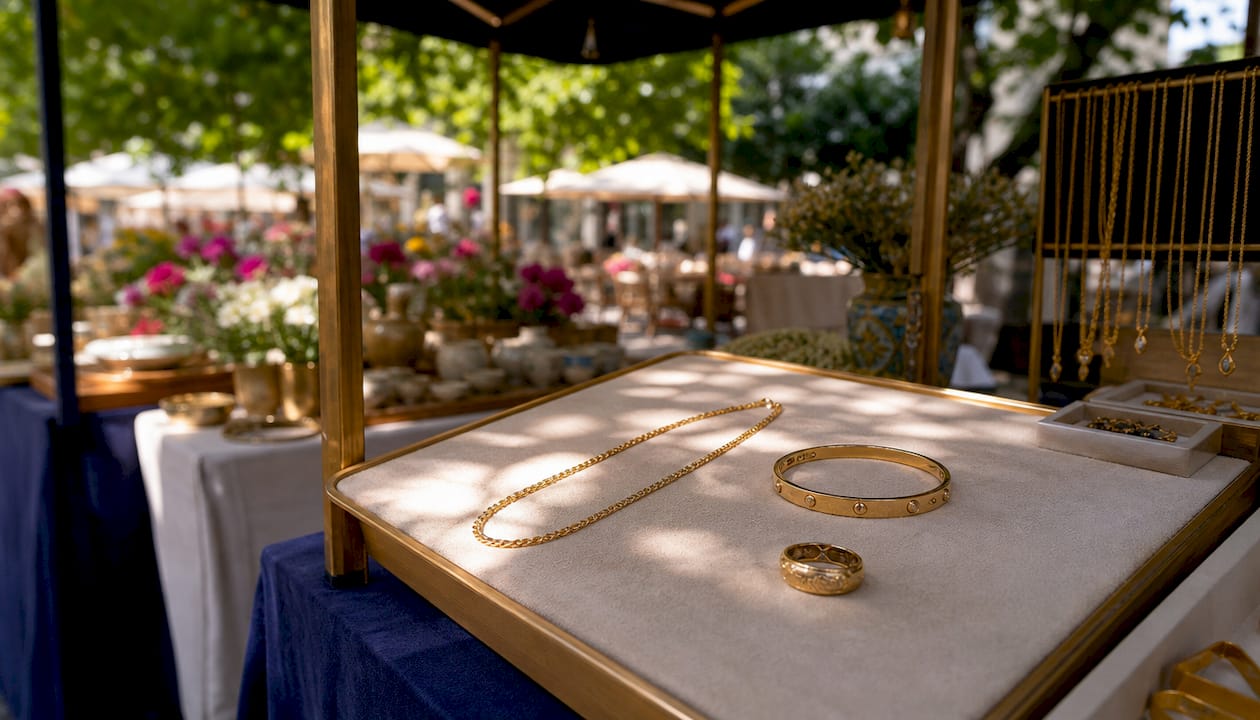
Branded pieces can pay 40–60% above scrap value, while broken chains typically sell close to melt value. Vintage and antique pieces may require auction to realise their full worth. Acceptance rates across buyers range from 65–99% depending on jewellery type and condition.
| Jewellery type | Typical acceptance rate | Payout vs scrap value | Best channel |
|---|---|---|---|
| Plain scrap gold (broken chains, damaged rings) | 95–99% | At or near melt value | Specialist dealer or online buyer |
| Standard gold rings and bracelets (good condition) | 85–95% | 80–95% of melt value | High street jeweller or online specialist |
| Branded or designer pieces | 70–85% | 40–60% above scrap | Auction house or specialist reseller |
| Vintage or antique jewellery | 65–80% | Variable, often above scrap | Auction house |
| Gemstone-set gold jewellery | 70–90% | Depends on stone quality | Specialist or auction |
Damaged or broken pieces are not worthless, but they will be valued almost entirely on their gold weight and purity. If your piece has stones, buyers may remove them before weighing, which can reduce the offer. Hallmarks matter too. A piece with a clear UK hallmark confirming purity (9ct, 18ct, 22ct) is easier to value and commands more confidence from buyers. Provenance, original receipts, or certificates can add meaningful value, particularly for designer or vintage items heading to auction.
Pro Tip: Get your jewellery hallmark checked before you sell. If the hallmark is worn or unclear, a reputable jeweller can help you identify the purity, which protects you from being undervalued.
What are the best selling channels for gold jewellery in the UK?
Choosing the right channel is arguably more important than timing the market. The difference between a poor channel and a good one can be hundreds of pounds on a single piece.
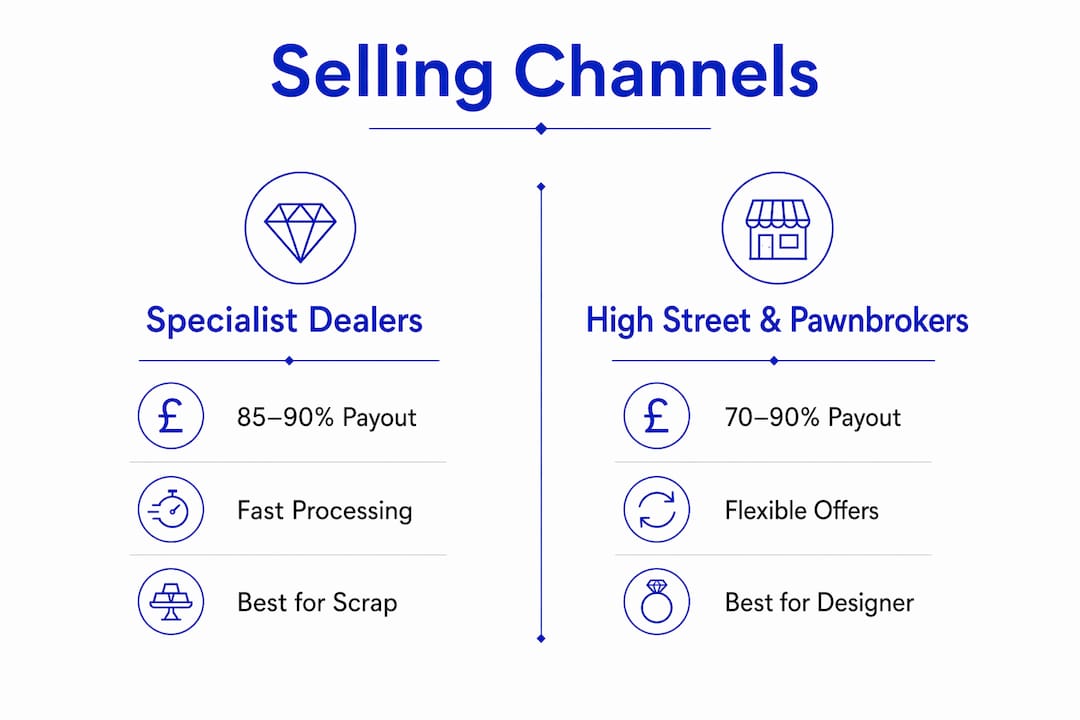
| Channel | Typical payout rate | Processing speed | Best for |
|---|---|---|---|
| Online specialist dealers | 85–90% of melt value | 1–5 days | Plain gold, scrap, standard pieces |
| High street jewellers | 70–90% of melt value | Same day | Convenience, mixed collections |
| Pawnbrokers | 70–85% of melt value | Same day | Speed, immediate cash |
| Auction houses | Variable, often above scrap (minus 10–25% commission) | 4–8 weeks | Designer, antique, collectible pieces |
| Private sales | Potentially highest return | Variable | Branded pieces with proven provenance |
Specialist dealers and online experts pay 85–90% of melt value, while high street jewellers pay 70–90% and pawnbrokers 70–85%. The gap between best and worst can be significant on higher-value pieces. Auction sales can exceed scrap value considerably for antique, designer, or collectible items, though auction commissions of 10–25% and timelines of 4–8 weeks need factoring in.
The best channel depends on the jewellery’s nature. Scrap or broken gold suits specialist dealers. Designer pieces benefit from auction exposure and competitive bidding. A plain 18ct gold ring is not going to attract a bidding war at Christie’s, but it will get a fair price from a reputable online specialist within days.
UK law requires gold buyers to verify your identity under anti-money laundering rules for transactions over £500. Bring photo ID and proof of address. Many buyers run these checks regardless of transaction value. This is standard practice, not a red flag.
Pro Tip: Always get at least three quotes before committing to a sale. The best price for gold varies more between buyers than most sellers expect. Fifteen minutes of comparison can add tens of pounds to your final offer.
How can you maximise the value when selling gold jewellery today?
Preparation is the least glamorous part of selling gold jewellery, and also the most overlooked. Yet cleaning and documenting your jewellery increases final sale values by an average of £15–30 per transaction. That is not nothing.
Here is what actually moves the needle:
- Clean your jewellery gently. Use warm water and mild washing-up liquid. A soft toothbrush works well for chains and settings. Buyers form first impressions quickly, and a clean piece signals care.
- Gather any documentation. Original receipts, valuation certificates, or hallmark certificates all add credibility. Designer pieces with original boxes and papers can attract significantly higher offers.
- Get a professional appraisal first. For anything you suspect is valuable beyond its gold weight, an independent appraisal before approaching buyers gives you a negotiating baseline.
- Compare multiple quotes. Never accept the first offer. Use at least three buyers across different channel types to understand the range.
- Consider timing within the year. Demand for gold jewellery tends to rise around festive seasons and Valentine’s Day. Selling into a period of higher consumer demand can improve offers, particularly for wearable pieces.
- Use postal services carefully. Postal gold buyers are convenient but require you to send your jewellery before receiving an offer. Use only fully insured, tracked services and check the buyer’s rejection and return policy before posting anything.
- Avoid buyers who pressure you. Legitimate UK gold buyers give you time to consider their offer. Any buyer who creates urgency or discourages you from getting other quotes is worth walking away from.
For practical strategies on getting the best price, preparation and channel choice consistently outperform market timing as the two biggest levers in your control.
Pro Tip: If your gold jewellery is damaged, consider whether a repair might increase its value before selling. A broken clasp on an otherwise excellent piece costs little to fix and can shift it from scrap value to full resale value.
Key takeaways
Selling gold jewellery in the UK right now is well-timed because prices remain historically high despite recent corrections, and preparation plus channel choice determine most of your final return.
| Point | Details |
|---|---|
| Gold prices remain strong | Despite a 15.6% correction, gold gained 33% over 12 months, keeping values historically high. |
| Jewellery type drives value | Branded and vintage pieces can pay 40–60% above scrap; broken gold sells near melt value. |
| Channel choice matters most | Online specialists pay 85–90% of melt value; auctions suit designer pieces despite longer timelines. |
| Preparation adds real money | Cleaning and documenting jewellery increases average payouts by £15–30 per transaction. |
| Legal checks are standard | UK buyers require photo ID and proof of address for transactions over £500 under anti-money laundering rules. |
Why I think the hesitation around selling right now is mostly unfounded
People ask me whether now is a good time to sell, and I always give them the same answer: compared to what? Compared to five years ago, gold prices are extraordinary. Compared to the all-time high of early 2026, they are slightly lower. But you are not a hedge fund trying to time the top of a commodity cycle. You are a person with a gold chain you have not worn since 2019.
The sellers I see making poor decisions are the ones who wait. They wait for the price to recover to its peak. Then it dips again. Then they wait again. Meanwhile, the jewellery sits in a drawer doing nothing. Gold does not pay you a dividend for holding it in a box.
What I have learned from watching the gold market trends over many years is that the sellers who do well are the ones who focus on what they can control. They clean their pieces. They get three quotes. They pick the right channel for the right item. They do not panic-sell during a dip, but they also do not hold out for a perfect moment that rarely arrives.
The current market is genuinely favourable. Prices are elevated by any reasonable historical measure. Demand from longer-term buyers remains solid. If you have gold jewellery you no longer want or need, the question is not really whether the market is good. The question is whether you are prepared to sell it well.
— James
Blackwelljewellers: trusted expertise for selling second-hand gold jewellery
If you are ready to take the next step, Blackwelljewellers has over 20 years of experience valuing and purchasing second-hand gold jewellery across Kent and online. The team at Blackwelljewellers brings genuine expertise to every valuation, whether you are selling a plain gold ring or a vintage hallmarked piece with a story behind it.

Blackwelljewellers operates physical stores in Maidstone, Gravesend, and Bexleyheath, as well as a national online platform, making it straightforward to get a fair, transparent offer wherever you are in the UK. Every piece is assessed honestly, with no pressure and no guesswork. Visit the second-hand jewellery page to find out what your gold jewellery could be worth today.
FAQ
Is now a good time to sell gold jewellery in the UK?
Yes. Gold remains one of the top-performing assets over the past 12 months despite a recent correction, and current UK prices are historically strong. Sellers with unwanted jewellery are in a favourable position.
How do I know what my gold jewellery is worth?
Check the hallmark to confirm purity (9ct, 18ct, or 22ct), then get at least three quotes from different buyer types. An independent appraisal is worth arranging for any piece you believe has value beyond its gold weight.
What ID do I need to sell gold jewellery in the UK?
UK anti-money laundering rules require photo ID and proof of address for transactions over £500. Many buyers request this documentation regardless of transaction value as standard practice.
Should I sell at auction or to a dealer?
Scrap and plain gold pieces suit specialist dealers, who typically pay 85–90% of melt value with fast processing. Designer, antique, or collectible pieces often achieve higher returns at auction, though commissions of 10–25% and timelines of 4–8 weeks apply.
Does cleaning my jewellery before selling actually make a difference?
Yes. Cleaning and providing documentation increases average payouts by £15–30 per transaction. A well-presented piece signals care and makes valuation easier, which typically results in a stronger offer.