

Buy from a seller who inspects, hallmarks and documents every piece before it goes on sale, not just the one with the shiniest listing photo. Check the hallmark yourself, ask for the paperwork (invoice, valuation, gem report), and confirm the returns policy before you part with any money. Do that, and second-hand jewellery becomes one of the smartest purchases you’ll make all year.
TL;DR:
- Buyers should verify hallmarks, paperwork, and the setting’s condition, especially for online listings, to avoid costly surprises.
- Trustworthy sellers inspect, hallmark, restore, and provide detailed documentation for each piece before sale.
- Prices vary widely depending on metal, stones, maker, condition, and provenance, with negotiations more likely on older or unsigned items.
- Always insist on hallmark authenticity, recent valuation, gem reports, and a transparent inspection process when purchasing.
- Insure the item before wearing and keep all receipts and documents, prioritizing seller accountability over the lowest price.
Table of Contents
- What to check before buying second hand jewellery near me
- Where can you buy trustworthy pre-owned jewellery?
- How much should you expect to pay for second hand jewellery?
- How do you verify a hallmark and paperwork?
- What should you do the moment you get it home?
- What does a genuinely reputable seller look like?
- Why the “cheapest option” advice on this topic is backwards
- Ready to view authenticated pieces near you?
- Sources
What to check before buying second hand jewellery near me
Right, here’s where most people go wrong: they fall in love with a ring on a Saturday afternoon and forget to actually look at it properly. Slow down. This is what a proper inspection looks like, whether you’re stood in a shop or squinting at photos on your phone.
- Look at the setting. Claws, clasps and prongs wear down over decades. Loose stones or a clasp that doesn’t snap shut properly are cheap fixes now, expensive regrets later.
- Check for resizing scars. A ring that’s been resized often shows a faint solder line inside the band. Not a dealbreaker, but you want to know before you buy, not after.
- Examine the stones. Chips, cloudy inclusions or an unusually perfect colour for the price can all be signs worth questioning.
- Ask for paperwork. A dealer invoice, the original receipt if it exists, a gem report, a valuation, and any service history. No paperwork, no purchase.
Walk away if a seller can’t produce a hallmark, the paperwork doesn’t match the item, or a repair has clearly happened but nobody mentioned it.
Pro Tip: Ask specifically for a close-up video of the setting and the inside of the band, not just the front-facing “hero shot.” Weak claws and old solder repairs hide in the details that catalogue photos are designed to avoid.
Where can you buy trustworthy pre-owned jewellery?
Not all sellers offer the same level of protection, and knowing the difference saves a lot of grief. Here’s the honest breakdown:
- Specialist pre-owned jewellers typically inspect, hallmark-check and often restore every piece before sale, and back it with a proper invoice and returns policy. This is the closest thing to a safety net you’ll find.
- High-street independent jewellers vary hugely. Some run genuine authentication processes; others are simply reselling stock with minimal checks, so ask directly what their process involves.
- Auction houses offer provenance and often detailed condition reports, but sales are usually final. Read the catalogue notes closely, because “as found” is doing a lot of quiet work in that phrase.
- Accredited dealers (look for membership of a recognised trade body) give you a route to complain if something goes wrong.
- Vetted online marketplaces can be reliable if the platform itself authenticates listings, but buyer protection depends entirely on the platform’s own policy, so read it before you bid.
- Private sellers offer the least protection of all. No returns, no guarantee, and verifying a hallmark from a phone photo is genuinely difficult.
If you want a shortcut through all of this, reputable online second-hand sellers tend to publish their inspection process openly. If a seller is vague about how they check items, that vagueness is the answer.
How much should you expect to pay for second hand jewellery?
Here’s the bit nobody tells you clearly enough: second-hand jewellery doesn’t have one price, it has a price range, and where a piece sits in that range depends on more than just the gold weight.
Plain, unsigned gold or silver pieces tend to price closest to their metal value, with a modest premium for condition and design. Signed or vintage pieces from a recognised maker command more, sometimes considerably more, because the signature itself carries value collectors will pay for. Diamond pieces sit somewhere in between, hugely dependent on the four Cs and whether the stone has been treated.
What actually moves the number: metal weight, gemstone grade, whether there’s a maker’s mark, current condition, provenance, and whether it’s recently been serviced or restored. A piece that needs re-tipping or a new clasp isn’t necessarily a bad buy, but factor the refurbishment cost into your offer, not into your regrets later.
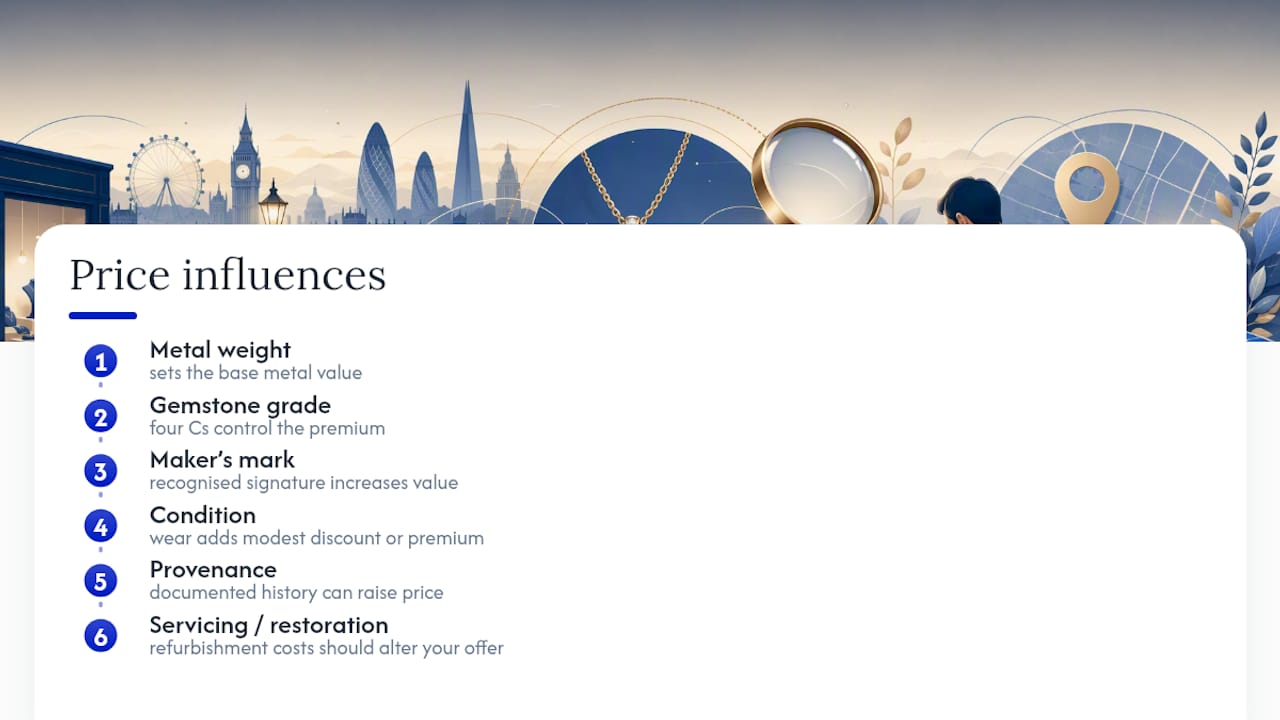
Sellers tend to have more room to negotiate on older stock or pieces that have sat in a cabinet a while. It’s always worth asking, politely, whether there’s flexibility, especially on unsigned pieces without collector demand.
How do you verify a hallmark and paperwork?
A UK hallmark is stamped into the metal itself, usually inside a ring band, on the clasp of a bracelet, or on the back of an earring post, and it tells you the fineness of the metal along with the assay office that tested it. Reading one takes practice, but a reputable dealer will happily talk you through what’s stamped on your particular piece.
Paperwork worth insisting on:
- The dealer invoice, stating metal, weight and any gemstone details
- A valuation, ideally recent, showing replacement cost rather than purchase price
- A gem report for diamonds or coloured stones above a certain value, listing carat, clarity, colour and cut
- Service history, if the piece has been restored or resized
For anything unsigned or above a few hundred pounds, an independent valuation is worth the outlay. Typical valuation fees that UK insurers and HMRC accept generally sit between £75 and £125, small money against the cost of getting a big purchase wrong.
What should you do the moment you get it home?
Insure it before you wear it out, not after. Photograph the piece from the front, back and any hallmarked areas, and keep every receipt and valuation document together in one place. Check whether your existing home contents policy actually covers newly acquired items in transit, because many don’t automatically, and arrange replacement-value cover if it falls short.
An insurance expert’s advice on estate jewellery is blunt on this point: insure to replacement value, not what you paid, since the two numbers can differ substantially.
Budget for routine care too. Clasps, prong tips and rhodium plating on white gold all wear over time, and a re-tip or replate every few years keeps a piece structurally sound rather than merely pretty.
What does a genuinely reputable seller look like?
Twenty years of trading teaches you which claims actually mean something and which are just words on a website. Blackwell Jewellers is family-run, has multiple stores across Kent, in Maidstone, Gravesend and Bexleyheath, and runs a national online platform alongside them, specialising specifically in inspecting, authenticating and restoring pre-owned pieces before they’re ever offered for sale.
What that looks like in practice:
- Every piece is hallmark-checked and inspected by an in-house jeweller, not a photo-only listing process
- Repairs, resizing and re-tipping happen in-house rather than being outsourced and forgotten about
- Documented provenance and valuation support are available, not bolted on as an afterthought
If you’re evaluating any seller, ask them directly: who inspects the item, what happens if a hallmark is missing, and can they produce a valuation on request? A seller with nothing to hide answers all three without flinching.
Why the “cheapest option” advice on this topic is backwards
Most guides to buying second-hand jewellery obsess over price comparison, as if the only variable that matters is how many pounds leave your account. That’s the wrong starting point. The real variable is accountability: who do you contact if the clasp fails in six months, or the hallmark turns out to be wrong?
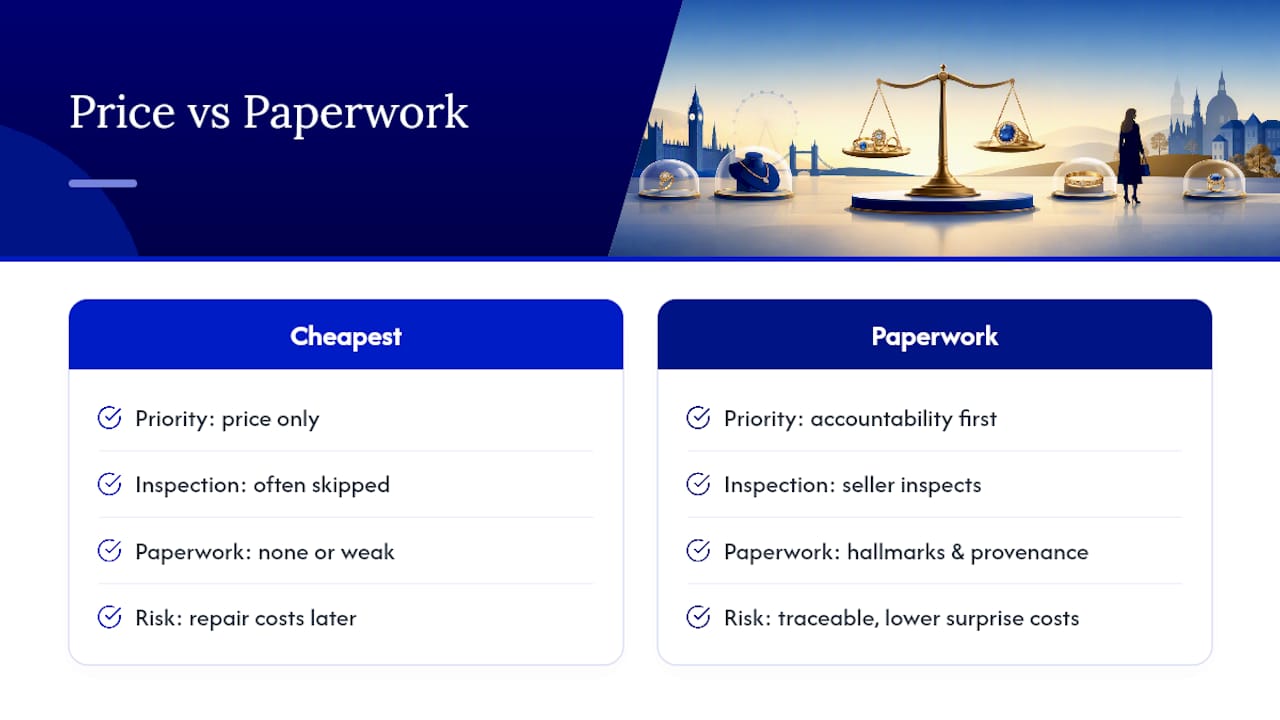
Buyers who skip inspection and paperwork to chase a marginally lower price often end up paying twice, once for the piece, once for the repair nobody disclosed. The research on this is consistent: pairing solid provenance paperwork with an independent valuation on higher-value pieces gives buyers the most genuine protection available, more than haggling ever will.
What should you prioritise first? Not the price tag. The paper trail. A slightly higher price from a seller who inspects, hallmarks and stands behind the piece afterwards beats a bargain from someone who can’t answer a basic question about their own stock.
— James
Ready to view authenticated pieces near you?
If everything above feels like a lot to check on your own, that’s precisely the gap a specialist pre-owned dealer is meant to close for you. This seller inspects, hallmarks and restores every second-hand piece in-house before it reaches a shelf or a listing, so the checklist above is already done by the time you see the item, and you get the paperwork to prove it.
Browse the current second-hand jewellery collection online, or visit the Maidstone store to see pieces in person and ask questions face to face. Want extra photos, a video, or a formal valuation before you commit? Just ask, that’s a normal request, not an awkward one. If a piece needs work down the line, in-house repairs are handled by the same jewellers who checked it in the first place. Get in touch or book a store appointment to start.