
You’ve got six real options for jewellery gathering dust in a drawer: repurpose it, sell it, donate it, recycle it, pawn it, or repair it and wear it again. Some routes put cash in your pocket fast, others preserve sentimental value, and a couple do both. The right choice depends on what you actually want out of the piece, which is exactly what we’ll work through.
TL;DR:
- Recycling jewellery generally provides the greenest option and can raise funds for charities, even if the items are broken or worthless-looking.
- Remaking old pieces into wearable items is often more satisfying and can preserve sentimental value while potentially increasing their final worth.
- Selling options vary: postal buyers offer quick quotes, auction houses favor provenance for high-value items, and pawnbrokers provide short-term loans rather than sales.
- Always check for hallmarks, photograph items, and get a valuation before sending jewellery anywhere to avoid low offers or loss.
- Proper documentation and proof of ownership are essential for sale or donation, especially for high-value or inherited pieces.
Table of Contents
- What can I do with old jewellery I don’t wear? Start here
- Repurpose or remake into new jewellery
- Sell for cash: postal buyers, auctions and pawnbrokers
- Donate or recycle through charity schemes
- Repair, restore or professionally clean pieces first
- Gift, pass on or safely store sentimental pieces
- Safety and valuation checks before you send anything
- Do you need proof of ownership to sell or donate jewellery?
- What Blackwell Jewellers has learned from years of remakes and resales
- Ready to do something with that old jewellery?
- Sources
- FAQ
What can I do with old jewellery I don’t wear? Start here
Before you do anything, decide what matters most to you: cash today, keeping the memory intact, helping a charity, or clearing clutter responsibly. That single decision filters out most of the noise.
- Want cash fast? Postal buyers and high-street shops pay quickest, though pawnbrokers offer a loan rather than a sale if you might want the item back.
- Want to keep the sentiment? Remodelling or gifting beats selling every time, even if the piece never fits your finger again.
- Want to help a charity? Recycling schemes take jewellery in any condition, broken chains and odd earrings included.
- Want the greenest option? Recycling reclaims metal and gemstones rather than sending them to landfill, and it usually raises money for a good cause at the same time.
Get a free valuation before deciding anything irreversible. A five-minute chat with a jeweller costs nothing and might reveal your “old costume piece” is solid silver, or your “worthless” ring has a hallmark worth checking.
Repurpose or remake into new jewellery
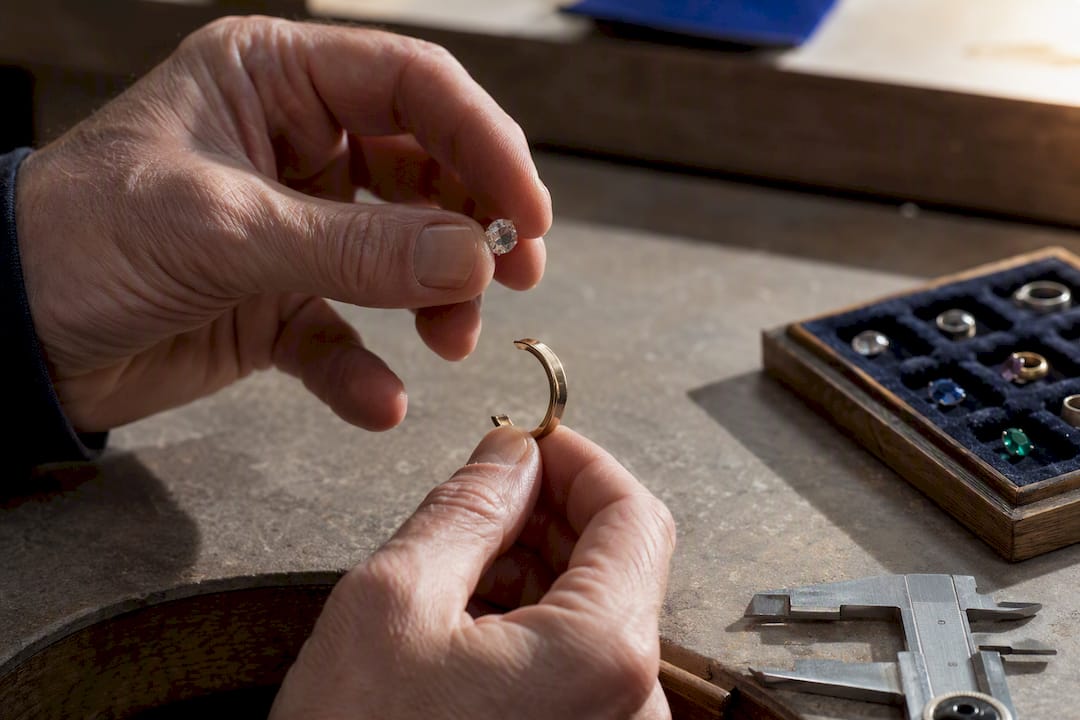
Turning an old piece into something you’ll actually wear is one of the most satisfying routes, and it’s more common than people think. Jewellers regularly reset a solitaire diamond into a pendant, combine two old wedding bands into one eternity ring, or melt down a tangle of mismatched gold into a single new piece. Grandma’s brooch becomes your everyday necklace. Dad’s cufflinks become earrings.
Bring photos of the original piece, any paperwork (valuations, receipts, hallmark certificates), and a rough idea of what you want. You don’t need a finished design; a Pinterest board or a sketch on the back of an envelope works fine.
A restorer will check the metal purity, the size and condition of any stones, and whether the structure can survive being reworked. Thin, worn bands sometimes can’t take another remodel without extra metal added.
Pro Tip: Always ask for a written quote before work starts. Remaking costs vary hugely depending on labour, added metal, and stone resetting, and prices can range from under £100 for a simple resize to several hundred pounds for a full remodel.
Timelines usually run two to six weeks. One thing worth knowing: remaking a piece can reduce its resale value if the original had collector or antique appeal, so check whether remaking old jewellery into a new ring makes more sense than selling it intact first.
Sell for cash: postal buyers, auctions and pawnbrokers
If cash is the goal, you’ve got three realistic routes, and they suit different pieces.
Postal buyers work in a fairly standard sequence: you send photos, they post a prepaid label, they run an XRF assay to confirm metal content, then they email a written offer. If you accept, you get paid. If you decline, most services return the item free of charge on an insured, tracked service.
High-street buyers pay instantly but often for less than postal specialists, since they’re weighing overheads into the price. Pawnbrokers give you a short-term loan against the item instead of a sale, which suits anyone who might want the piece back once funds improve.
- Photograph and weigh items before sending anything anywhere.
- Ask for an itemised breakdown, not a single lump-sum figure.
- Cross-check the offer against current LBMA gold and silver prices before accepting.
- Insist on insured, tracked posting both ways.
For designer names, signed pieces, or genuine antiques, an auction house typically outperforms a scrap-value offer, because collectors bid on provenance and rarity rather than melt weight. Auction houses generally offer free valuations upfront, so there’s no cost to finding out whether your piece belongs there instead.
Donate or recycle through charity schemes
Broken chains, single earrings, tangled costume pieces, old watches: charities want all of it. You don’t need to sort or clean anything first.
- Contact a charity recycling scheme, such as Heart Research UK’s jewellery donation programme, or a national partner like Recycling for Good Causes.
- Request a free envelope for small donations, or a larger sack if you’re clearing out a substantial amount of items.
- Pack everything into one bag inside the envelope or sack so nothing gets separated in sorting.
- Post it using the provided freepost label, or arrange a courier collection for bigger amounts.
- Wait for confirmation. Reputable schemes will tell you your donation has arrived and, in many cases, roughly what it raised.
Charities often work with recycling partners who take a commission, sometimes cited around 25% by Heart Research UK, to cover processing costs, with the rest going to the cause. Some, like Against Breast Cancer’s auction-based scheme, route donations through auction houses with no commission taken, so the full sale price supports the charity. Either way, even broken and worthless-looking items carry recoverable metal value, which is why Macmillan Cancer Support also partners with recycling schemes rather than turning donations away.
Repair, restore or professionally clean pieces first
Sometimes the old jewellery you don’t wear just needs fixing, not replacing. A loose stone, a snapped chain, a ring that’s gone dull and scratched: these are usually quick, affordable jobs.
- Stone tightening or re-tipping: cheap, fast, and stops you losing a diamond down the sink.
- Soldering a broken chain or clasp: often done same-day at a local jeweller.
- Rhodium plating: restores shine to white gold that’s turned yellowish, typically a same-week turnaround.
A jeweller will assess whether repair is worth it against the piece’s value; a £15 repair on a £20 costume ring rarely makes sense, but the same repair on a gold heirloom almost always does. Restoration also extends how long you’ll actually wear something, rather than it sitting unworn because of one small fault. Always get a written estimate and turnaround time before handing anything over.
Gift, pass on or safely store sentimental pieces
Not every piece needs a decision today. If something carries real memory, sentimental pieces are worth handling more carefully than a straightforward sale.
- Decide whether to gift it now, name it in a will, or simply keep it stored.
- Photograph the item and note its provenance, including any past valuations, before passing it to someone else.
- Store valuables in a fireproof safe or bank deposit box, and check with your insurer whether high-value pieces need separate cover.
- Talk to family early about who wants what. Assumptions about heirlooms cause more arguments than the jewellery is usually worth.
Safety and valuation checks before you send anything
A few checks take five minutes and can save you from a lowball offer or a lost item entirely.
- Check for hallmarks on the metal; they confirm purity and sometimes the maker.
- Photograph every piece individually and keep a written list with weights if you know them.
- Use insured, tracked postage, such as Royal Mail Special Delivery, for anything valuable.
- Ask for a proper itemised valuation or an XRF assay result rather than a single guessed figure.
- Keep receipts for anything you sell, and confirm the buyer offers free return postage if you decline their offer.
Pro Tip: Never send jewellery anywhere without photographing it first. If a parcel goes missing, that photo (ideally with a ruler or scale in shot) is your evidence for an insurance claim.
Do you need proof of ownership to sell or donate jewellery?
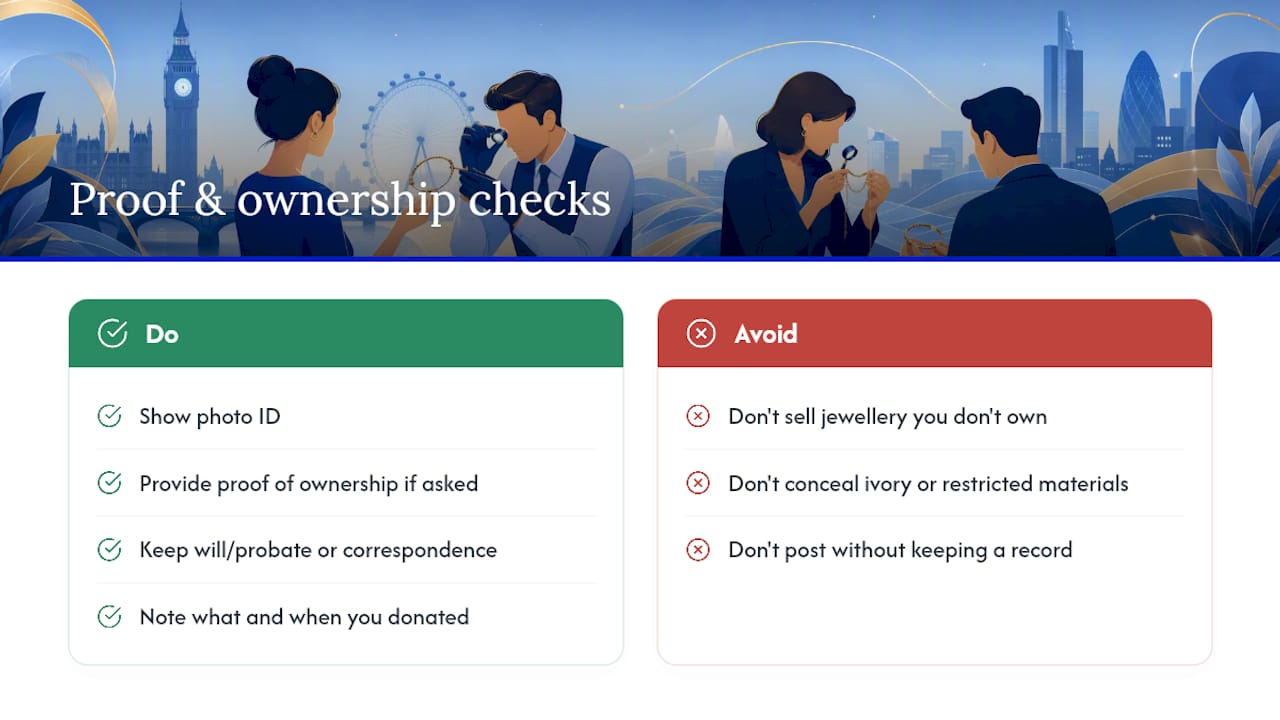
Reputable buyers and auction houses in the UK are required to carry out identity and, in some cases, ownership checks before accepting jewellery for sale, particularly for higher-value items. This isn’t bureaucracy for its own sake; it’s part of anti-money-laundering rules that apply to the secondhand and precious metals trade. Expect to show photo ID, and be ready to explain how you came to own the piece if asked, especially for inherited jewellery without paperwork.
Selling something you don’t legally own, even unknowingly (a piece left to someone else in a will, for example), can create real problems later. If you’re handling a deceased relative’s estate, keep any will, probate documents, or family correspondence that shows the jewellery passed to you legitimately before you sell or donate it.
Restricted items are rarer than people assume, but they exist. Ivory, certain tortoiseshell pieces, and some antique materials fall under separate wildlife and conservation rules that have nothing to do with the metal or gemstone value. If a piece looks genuinely old and includes unusual materials, mention this to whoever you’re selling to or ask a jeweller to check before you post anything.
Donating to a charity scheme carries far fewer formalities than selling, since no money changes hands directly with you. Even so, it’s worth keeping a note of what you sent and when, particularly if the parcel goes astray and you need to query it later.
What Blackwell Jewellers has learned from years of remakes and resales
Every piece that crosses our counter gets checked for hallmarks, weighed, and assessed structurally before we’ll quote a price for buying, remaking, or restoring it. We’ve seen too many people scrap or sell pieces for melt value that were actually worth far more intact, simply because nobody checked the hallmark first.
The biggest mistake is guessing. A five-minute inspection at a local jeweller costs nothing and often changes the decision entirely, whether that means selling, remaking, or keeping the piece as it is.
— James
Ready to do something with that old jewellery?
If you’ve read this far wondering whether selling online, mailing off to a stranger, or waiting weeks for an auction house is really your only choice, it isn’t. You can choose a face-to-face alternative in Kent, with hallmarking, weighing, and structural assessments done in front of you rather than in a warehouse you’ll never see.

We buy and sell through our second-hand jewellery marketplace, take on bespoke remakes and full repairs in-house, and offer pawnbroking if you’d rather borrow against a piece than part with it permanently. Every second-hand item sold typically has been through an authentication process to ensure quality.
The simplest next step is a free, no-obligation valuation at one of our Kent stores, or through our Maidstone second-hand and valuation service. Bring the piece in, and you’ll walk out knowing exactly what it’s worth and which option actually fits it.
Sources
- Save lives by donating your unwanted jewellery | Heart Research UK
- Recycling for Good Causes — Individual donors
- Sell jewellery | Dawsons Auctions
FAQ
What should I do with grandma’s old jewellery?
Photograph and document each piece first, then decide between keeping it for sentimental value, having it remade into something wearable, or getting it valued before selling. Check for hallmarks before assuming a piece has no monetary value.
How do I repurpose jewellery I never wear?
Take it to a jeweller who can reset stones, combine metals from multiple pieces, or remodel it entirely into a new design you’ll actually wear, using your original photos and paperwork as a starting reference.
What is the 2:1:1 rule in jewellery?
There’s no widely recognised industry standard called the “2:1:1 rule” in jewellery valuation or design; definitions circulating online vary and aren’t consistent enough to state as fact here.
What should I do with a deceased person’s jewellery?
Keep any will, probate paperwork, or documentation showing you legitimately inherited the item, since buyers and auction houses may ask for proof of ownership before accepting higher-value pieces. From there, the same choices apply: keep, gift, remake, sell, or donate.
Do charities really want broken jewellery?
Yes. Schemes like Recycling for Good Causes accept broken chains, odd earrings, and damaged costume pieces alongside gold and silver, since the materials still carry recoverable value.