

If you do not repay a pawn loan in the UK, the pawnbroker can sell your pledged item to recover the debt. That’s the short version. The slightly longer version? You won’t be chased by debt collectors, your credit score is normally unaffected, and you still have rights — including the right to any surplus if the item sells for more than you owe.
Here’s what to do right now if you’re worried about missing a repayment:
- Check your ticket. The maturity date is printed on it. That’s your deadline.
- Contact the pawnbroker before that date. Most will discuss an extension or renewal.
- Ask for a written redemption figure — the exact amount (capital + interest + fees) needed to get your item back.
- Consider your options: redeem, renew, agree a sale, or get free debt advice from Citizens Advice or MoneyHelper.
The consequences of defaulting on a pawn loan are real, but they’re also manageable if you act early. Read on for the full picture.
Table of Contents
- How does a pawn loan actually work in practice?
- What’s the typical timeline from loan to sale?
- What are your legal rights if you don’t repay?
- What if you’ve lost the ticket?
- How do you redeem your item step by step?
- What are your options if you simply can’t repay?
- How is pawnbroking regulated in the UK?
- What to expect from a reputable UK pawnbroker: the Blackwelljewellers approach
- Key takeaways
- The bit I actually want to say about pawn loans
- Blackwelljewellers pawnbroking: what to bring and what to expect
- Useful sources and where to get free help
How does a pawn loan actually work in practice?
A pawn loan is a short-term, secured loan. You hand over an item (the pledge), the pawnbroker lends you money against its value, and you get a ticket (a receipt and contract in one). That ticket is your proof of ownership and your key to getting the item back. Lose it, and things get complicated (more on that shortly).
The maturity date is when the loan term ends. At that point, you either redeem the pledge (pay back the loan plus interest and fees) or the pawnbroker can begin the process of selling it. The term is usually six months, though some agreements are shorter.
Renewal or extension means paying the interest due and rolling the loan over for another term. You keep the item in hock, the clock resets. It’s useful if you need more time, but the fees stack up.
“Pawn loans involve no hard credit checks and the primary consequence of default is forfeiture of the collateral, not a negative credit rating or debt collection action in most cases.” — Citizens Advice, Pawnbrokers
Interest is charged on the outstanding loan amount, and the total cost can be surprisingly high over several months. That’s the bit people underestimate. Pawning is short-term emergency finance — not a long-term solution.
Pro Tip: Before you pawn anything, calculate the total repayment (loan + all interest + fees) and compare it with what you’d get selling the item outright. Sometimes selling makes more sense, especially for items you’re not emotionally attached to.
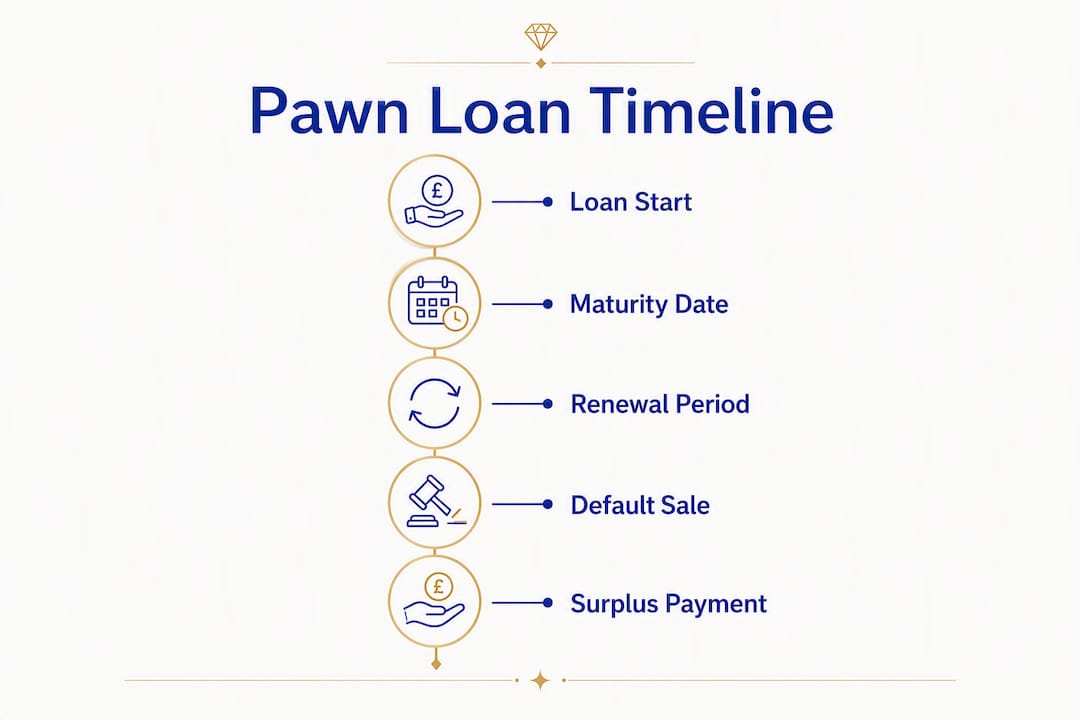
What’s the typical timeline from loan to sale?
The process isn’t instant. There are statutory steps the pawnbroker must follow before your item is sold, and you have windows to act at each stage.

| Stage | What happens | Your window to act |
|---|---|---|
| Loan start | You hand over the item, receive the ticket and loan funds | Keep the ticket safe |
| Maturity date | Loan term ends; item becomes “realisable” | Redeem or renew before this date |
| Small loans (£75 or under, 6-month term) | Ownership passes automatically to the pawnbroker at the end of the redemption period | No further redemption right after this point |
| Larger loans (over £75) | Pawnbroker issues a notice of intention to sell | You still have a short window to redeem after notice |
| Notice period (loans over £100) | Written notice must be given before sale | Pay the redemption figure or negotiate |
| Sale | Pawnbroker sells the item; proceeds applied to debt | Request sale particulars and surplus if applicable |
The £75 threshold is the one that catches people out. For a loan of £75 or less with the standard six-month redemption period, ownership transfers automatically once that period expires. No notice, no further chance to redeem. For anything above that, the pawnbroker must issue notice before selling.
Always check the maturity date on your ticket. Don’t guess.
What are your legal rights if you don’t repay?
The good news first: pawn loans are non-recourse in practice. That means if the pawnbroker sells your item and the proceeds don’t cover the full debt, you’re generally not pursued for the shortfall the way you would be with an unsecured loan. No debt collectors turning up. No county court judgement for the difference.
Your credit score is also normally unaffected. Pawnbrokers don’t typically report to credit reference agencies, so a missed pawn repayment won’t show up on your Experian, Equifax, or TransUnion file.
Here’s where it gets interesting: surplus proceeds belong to you.
| Scenario | What happens to the money |
|---|---|
| Item sells for more than you owe | Surplus must be paid to you by the pawnbroker |
| Item sells for less than you owe | Debt is reduced; shortfall generally not pursued |
| Item sells for exactly the redemption sum | Debt cleared; nothing further owed |
Under Section 121 of the Consumer Credit Act 1974, the pawnbroker must give you prescribed notice before the sale, and after the sale they must provide written information about the sale proceeds and expenses. If the net proceeds (gross sale price minus reasonable selling expenses) exceed what you owed, that surplus is yours.
“Section 121 requires the pawnbroker to give prescribed notice of intention to sell and to report sale proceeds and expenses after sale; surplus proceeds belong to the pawnor where the net proceeds exceed the redemption sum.” — Consumer Credit Act 1974, s.121
If you think the item was sold at undervalue, or that the pawnbroker claimed unreasonable selling expenses, you can challenge it. The burden is on the pawnbroker to demonstrate they took reasonable care and incurred only reasonable costs. Keep all your paperwork.
What if you’ve lost the ticket?
This is more common than people admit, and it’s not the end of the world — but it does create extra work.
The ticket is your proof that you’re the rightful owner of the pledged item. Without it, the pawnbroker has no way of knowing you’re not a stranger trying to claim someone else’s property. That’s a reasonable concern on their part.
Practical steps if your ticket is lost:
- Contact the pawnbroker as soon as possible — don’t wait until the maturity date.
- Bring valid photo ID (passport or driving licence).
- Bring any proof of purchase or ownership for the item (original receipt, insurance documents, photographs).
- Be prepared to complete a written declaration or statutory form confirming ownership.
- If theft or fraud is involved (someone else has your ticket and is trying to redeem your item), contact the police and seek legal advice immediately.
Pro Tip: Take a photo of your pawn ticket the day you receive it and store it somewhere safe (a cloud folder works well). It takes ten seconds and could save you a lot of hassle.
For loans over £100, the pawnbroker must send notice of sale to your address on file. If you’ve moved, update your contact details with the pawnbroker — otherwise that notice may never reach you, and you’ll lose your window to act.
How do you redeem your item step by step?
Redeeming your item is straightforward if you’re organised. Here’s the process:
- Find your ticket. You’ll need it. If it’s lost, follow the steps in the section above first.
- Check the redemption amount. This is the loan capital plus all accrued interest and any fees. Ring or visit the pawnbroker and ask for the exact figure in writing.
- Ask about extensions. If you can’t pay the full amount right now, ask whether a renewal is possible and what it would cost. Get the figures in writing.
- Ask about selling. If you’d rather not pay the redemption sum, ask whether the pawnbroker will accept the item as a sale instead. You may receive any surplus above the loan amount.
- Visit the pawnbroker with your ticket and photo ID. Both are required. No ticket, no redemption (unless you’ve completed the lost-ticket process).
- Pay by an accepted method. Confirm in advance whether they take card, cash, or bank transfer.
- Get a receipt confirming the loan is cleared and the item has been returned to you.
Common extra costs to watch for: overdue interest (charged daily or monthly after the maturity date), storage fees, and any administration charges. Always confirm the final total before you hand over any money. A good pawnbroker will give you this in writing without you having to ask twice.
For a fuller picture of what loan amounts to expect against jewellery, Blackwelljewellers’s guide on pawning jewellery is worth a read before you visit.
What are your options if you simply can’t repay?
You’ve got more choices than you might think. None of them are perfect, but some are a lot better than just letting the loan lapse without a word.
- Renew or extend the agreement. Pay the interest due and roll the loan over. Buys you more time, but the total cost keeps climbing. Compare the cumulative interest against the item’s resale value before committing to another term.
- Agree a sale with the pawnbroker. Instead of redeeming, you authorise the pawnbroker to sell the item on your behalf. If it sells for more than you owe, you receive the surplus. This is often the cleanest option when you know you won’t be redeeming.
- Sell the item elsewhere first. If you can sell privately or through a specialist reseller before the maturity date, you might clear the loan and keep more of the value. For watches, for example, selling through a specialist can return significantly more than a pawnbroker’s sale price.
- Seek short-term finance from another source. Credit union loans, employer salary advances, or family loans may cost less than rolling over a pawn agreement repeatedly. Compare the total cost honestly.
- Get free debt advice. If pawn loan repayment issues are part of a wider financial problem, don’t go it alone. Citizens Advice and MoneyHelper (0800 138 7777) offer free, impartial guidance. StepChange (stepchange.org) is also excellent for structured debt support.
Pro Tip: Always compare the total cost of renewal against what you’d net from an outright sale. If the item is worth £300 and you owe £200 with another £40 in renewal fees, a sale that nets you £260 leaves you £60 better off than renewing.
How is pawnbroking regulated in the UK?
Pawnbroking is a regulated consumer credit activity. That matters because it means you have enforceable rights, not just goodwill from the shop.
The key framework:
- Consumer Credit Act 1974 — sets out the rules for pledges, redemption rights, notice of sale, and surplus proceeds. Section 119 makes it a criminal offence for a pawnbroker to refuse redemption without reasonable cause.
“If a person who has taken a pawn under a regulated agreement refuses without reasonable cause to allow the pawn to be redeemed, he commits an offence.” — Consumer Credit Act 1974, s.119
When making a complaint, gather: your pawn ticket, any written communications, receipts, and a record of dates and amounts. The more paper you have, the stronger your position.
This article is general information, not legal or financial advice. For your specific situation, consult Citizens Advice, MoneyHelper, or a qualified adviser, and check current rules with the FCA or relevant primary source.
What to expect from a reputable UK pawnbroker: the Blackwelljewellers approach
Knowing what a responsible pawnbroker looks like in practice helps you spot when something’s off. Blackwelljewellers, a family-run jeweller with over 20 years of trading across Kent (Maidstone, Gravesend and Bexleyheath), handles missed repayments with a clear, customer-first process.
Here’s what the typical flow looks like at a reputable shop:
- Initial contact. The customer brings the item in. Staff verify identity and the item’s condition, and explain the loan terms, interest rate, and maturity date clearly before anything is signed.
- Ticket issued. A formal pawn ticket is provided, documenting the loan amount, term, maturity date, and redemption conditions. You leave with a written record of everything.
- Maturity approaches. The pawnbroker will typically make contact before the maturity date to remind you and discuss options (redeem, renew, or sell).
- If you can’t repay. Staff explain the redemption figure, the renewal cost, and the sale option in plain language. No pressure, no jargon. You get a written statement of amounts due and a clear timetable for any potential sale.
- Item inspection and authentication. Blackwelljewellers inspects and authenticates jewellery before and after the loan period. Condition is documented, which protects both parties if a dispute arises.
- Surplus proceeds. If the item is sold and the net proceeds exceed what you owe, the surplus is returned to you. Full stop.
Trust signals to look for in any pawnbroker: hallmarking documentation, written condition reports, clear fee schedules, and FCA authorisation. These aren’t optional extras — they’re what separates a responsible lender from a cowboy operation.
For a deeper look at how the in-store process works, Blackwelljewellers’s pawnbroking guide walks through each step in detail.
Key takeaways
If you don’t repay a pawn loan in the UK, you lose the pledged item to sale — but your credit score is normally unaffected, you won’t be chased for any shortfall, and you’re entitled to any surplus proceeds.
| Point | Details |
|---|---|
| Primary consequence | The pawnbroker may sell your pledged item; you are not typically pursued for any shortfall. |
| Credit score impact | Pawn loans are not usually reported to credit reference agencies, so default rarely affects your credit file. |
| Surplus proceeds | If the item sells for more than you owe, the surplus must be returned to you under the Consumer Credit Act 1974. |
| Act before the maturity date | Check your ticket, contact the pawnbroker early, and ask about renewal or sale options before the notice period expires. |
| Blackwelljewellers | Offers transparent, FCA-compliant pawnbroking in Kent with written records, item authentication, and clear surplus-proceeds handling. |
The bit I actually want to say about pawn loans
Here’s what most articles on this topic get wrong: they treat the loss of the item as the worst-case scenario. It isn’t, always.
The genuinely bad outcome is paying renewal fees month after month on an item you’re never going to redeem, until you’ve paid more in interest than the item is worth — and then losing it anyway. That’s the slow-motion version of the same result, except you’ve also handed over a chunk of cash for nothing.
The non-recourse nature of pawn loans is actually one of their most underrated features. You can’t lose your house over a pawn loan. You can’t be dragged into a debt spiral by a pawnbroker chasing a shortfall. The item is the debt. That’s a meaningful protection, and it’s worth understanding properly rather than panicking about credit scores that aren’t at risk.
What I’d push back on is the idea that pawnbroking is inherently a last resort for desperate people. Used correctly, with a clear plan to redeem and a realistic assessment of the total cost, it’s a legitimate short-term liquidity tool. The problem is when people use it without reading the ticket, without understanding the maturity date, and without asking the one question that matters most: “What is the total cost if I renew twice before redeeming?”
Ask that question before you sign anything. The answer will tell you everything you need to know.
Blackwelljewellers pawnbroking: what to bring and what to expect
Pawning jewellery with a pawnbroker you can actually trust makes a real difference — especially when repayment gets complicated. Blackwelljewellers offers responsible pawnbroking services across its Kent stores, with transparent terms, written documentation, and in-house jewellery authentication on every item.

What to bring when you visit:
- Your pawn ticket (if you’re redeeming or renewing)
- Valid photo ID (passport or driving licence)
- Proof of ownership where possible (original receipt, insurance documents)
In store, you’ll get a clear explanation of your redemption figure, renewal options, and the sale process if relevant. Every item is inspected and documented. If you’re considering selling rather than redeeming, the team can advise on current values and your options.
Ready to sort it out? Visit the Blackwelljewellers Maidstone pawnbroking page to find your nearest store, check opening hours, and get in touch before your maturity date arrives.
Useful sources and where to get free help
- Citizens Advice — Pawnbrokers: Plain-English overview of pawnbroking rights, what happens if you can’t repay, and how to get help. Start here.
- Consumer Credit Act 1974, s.121 — Realisation of pawn: The primary legislation on notice of sale, surplus proceeds, and your rights after a sale. Read this if you’re considering a formal challenge.
- Consumer Credit Act 1974, s.119 — Unreasonable refusal to deliver pawn: Confirms it’s a criminal offence for a pawnbroker to refuse redemption without reasonable cause.
- HMRC VATFIN3180 — Pawnbroking: The HMRC internal manual covering the £75 threshold, ownership transfer rules, and VAT treatment. Useful for the statutory detail.
- StepChange (stepchange.org): — Free debt advice charity. If pawn loan repayment issues are part of a wider debt problem, StepChange offers structured support and debt management plans.