

A court-shaped wedding ring is a band with a rounded profile on both the inside and outside, giving it a soft, oval cross-section rather than sharp edges. That double curve is what makes it a comfort-fit classic: the domed interior slides over your knuckle with far less friction than a flat-backed band, which is exactly why it’s remained the most reached-for wedding ring shape in Britain for generations.
TL;DR:
- Court wedding rings generally feel more comfortable by reducing contact points and preventing moisture buildup, especially useful for wider or men’s bands.
- They may sit slightly raised against flat engagement rings, creating a small gap that can be addressed with custom shaping or choosing flat bands if flush fit is essential.
- Trying both the same width in court and flat profiles on your hand before purchasing ensures comfort and proper fit, particularly for daily wear and finger fluctuations.
- Metal choice influences durability and resizing; platinum and higher-carat gold metals resell and reshape better, which is critical for longevity and stability.
- The rounded profile often appears less dramatic visually but offers significant ergonomic benefits that are overlooked when choosing wedding rings based solely on appearance.
Table of Contents
- What does the court profile actually look like?
- Why do court rings actually feel more comfortable?
- Court vs D-shape vs flat: what you’ll actually notice trying them on
- Which width and metal suit a court profile best?
- Will a court band sit flush against my engagement ring?
- How do you actually choose and buy the right court ring?
- How Blackwelljewellers approaches comfort-fit rings
- Comfort beats convention, and the market still hasn’t caught up
- Ready to try a court-shaped ring for yourself?
- Sources
- FAQ
What does the court profile actually look like?
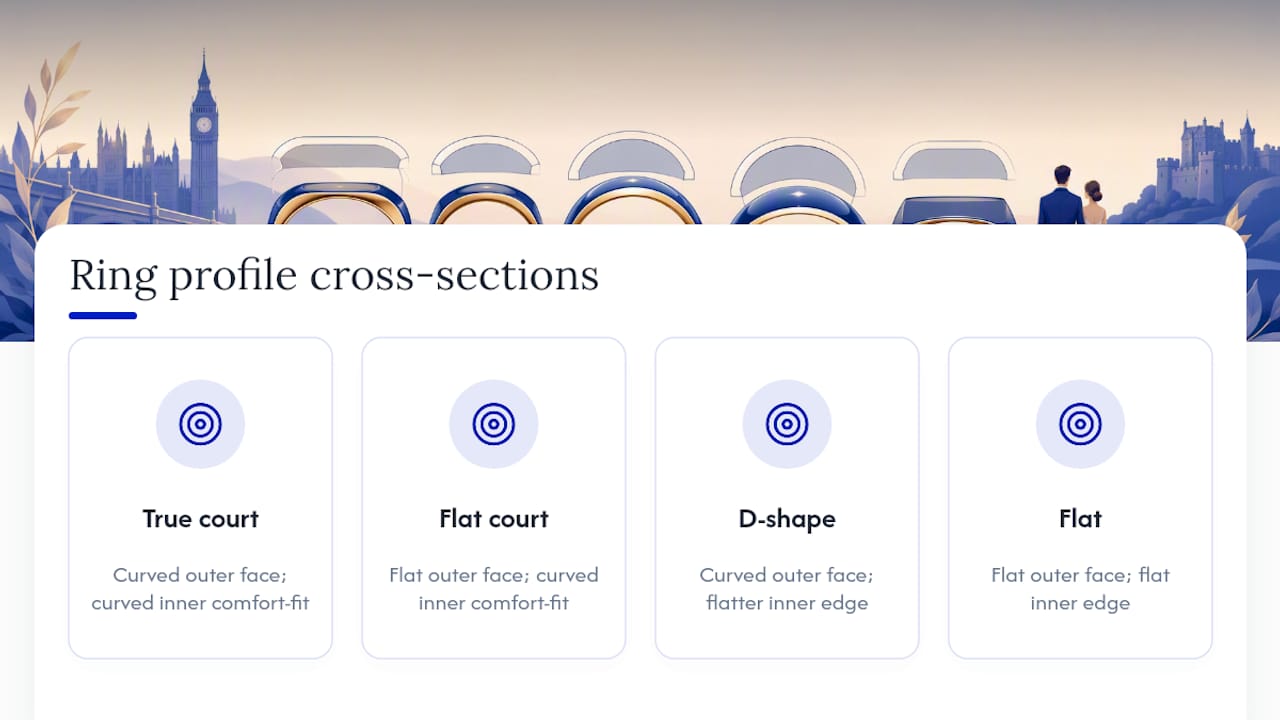
Picture a band with no flat surfaces at all. Slice it through and you’d see a soft oval, rounded on the outside face you can see and rounded again on the inside face that sits against your skin. That inner curve is what the trade calls “comfort fit”, and it’s worth separating from the outer shape, because comfort fit specifically describes the interior, not the whole ring. A domed exterior is a different, cosmetic feature that happens to appear on most court rings anyway.
This is where the naming gets murky. You’ll hear “court”, “flat court”, “D-shape” and “flat” thrown around as though they’re interchangeable, and British jewellers actually treat them as four distinct combinations of interior and exterior curve. A true court has curves on both sides. A flat court has a flat outer face but a comfort-fit interior. A D-shape rounds the outside but keeps a flatter inner edge. Flat profiles have no curve at all, inside or out.
Why do court rings actually feel more comfortable?
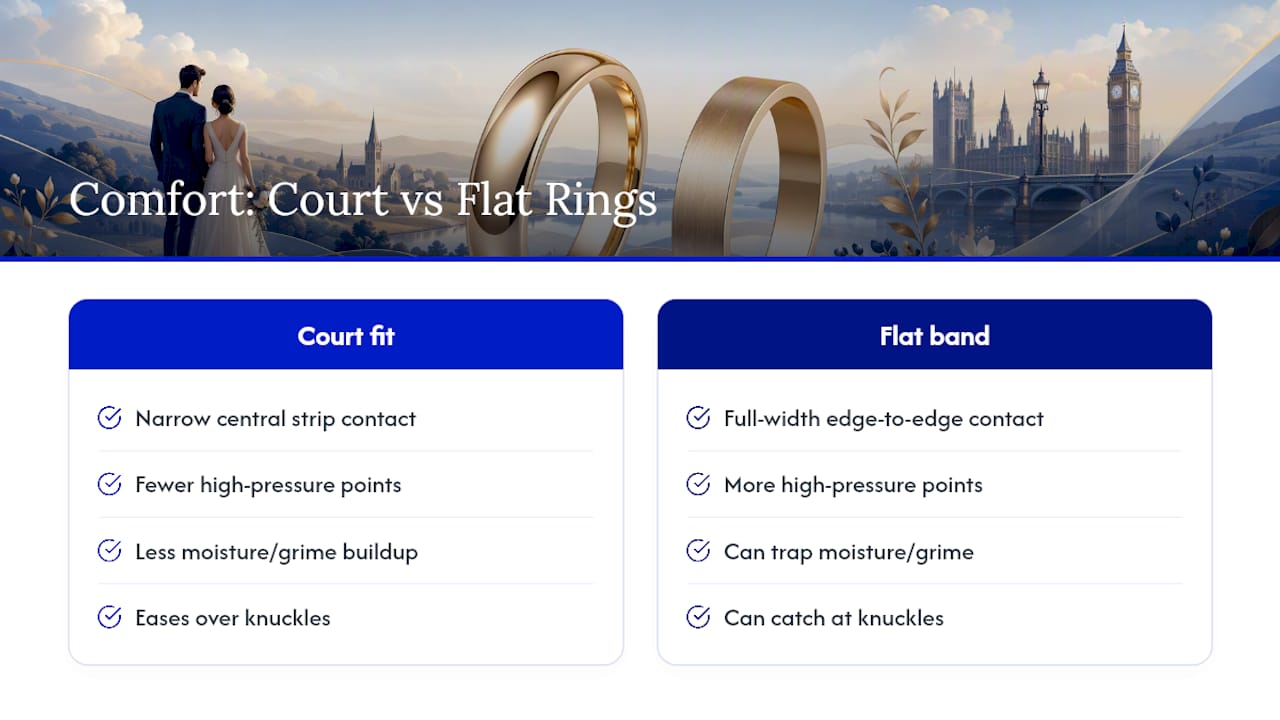
The comfort comes down to contact area, not marketing. A court interior reduces the surface touching your skin, because the dome only meets your finger along a narrower central strip rather than gripping it edge to edge like a flat band does. Less contact means fewer pressure points, and it’s the pressure points, not the metal itself, that make a ring feel tight by mid-afternoon.
There’s a second, quieter benefit too. The same convex interior that eases the ring over your knuckle also stops moisture and grime collecting along a sharp inner edge, which matters more than people expect if you wash your hands a lot or work with them.
Court rings show measurably improved pressure distribution. The ergonomic analysis behind wedding ring profiles found that a domed interior narrows the actual contact zone against the finger, cutting the high-pressure areas a flat-backed ring creates at the same width.
This is precisely why court profiles get recommended for wider bands, for anyone whose knuckle is noticeably larger than the base of their finger, and for people whose hands swell during manual work or exercise. Wider bands and men’s wedding rings in particular benefit from the comfort-fit interior, because width alone increases contact area, and the court shape is what claws that back.
Court vs D-shape vs flat: what you’ll actually notice trying them on
Slide a flat band on and you feel edges, especially at the base of your finger where a flat interior meets skin at an angle. A D-shape softens the outside but keeps enough flatness inside that you’ll still notice some resistance over the knuckle. A court ring, by contrast, glides.
Here’s the part that catches people out in-store: court rings often feel roomier than a flat ring in the same nominal size, purely because the narrower contact point needs less clearance to pass your knuckle. Don’t assume your usual size carries across profiles without trying both.
There’s an aesthetic trade-off worth knowing before you fall for a design. Court and D-shape rings both catch light differently to a flat band, throwing a soft highlight down the centre rather than a single flat plane. When you’re stacking against a flat-faced engagement ring, that rounded outer edge is also the reason for the small gap you’ll read about below.
Which width and metal suit a court profile best?
Court profiles tend to show clear comfort advantages at widths that are generally considered moderate to wide, particularly noticeable with men’s widths where the difference compared to flat bands becomes apparent during daily wear.
Metal choice interacts with the shape more than most buyers realise. Higher-carat gold and platinum are more ductile, meaning they resize more easily and hold their polish through repeated adjustments, while 9ct gold and some modern alloys such as titanium have tighter resizing limits. If your finger size is likely to shift, ask about that before you commit. A comparison of men’s wedding ring metals is worth reading if width and weight are your main concern.
The arched geometry of a court band also distributes wear more evenly across the metal, which tends to make it more resistant to denting than an equivalent flat profile of the same weight. It’s one reason a court ring can feel sturdier in daily use despite carrying less metal than you’d expect. For a deeper look at what actually survives decades of wear, see this guide to durable wedding ring metals.
Will a court band sit flush against my engagement ring?
Probably not perfectly, and that’s worth knowing before the big day rather than after. A court band’s rounded outer edge means it can sit slightly raised where it meets a flat-faced engagement ring, leaving a small visible gap along one side.
You’ve got three honest options. Choose a flat wedding band instead if flush stacking matters more to you than the comfort-fit interior. Get a contoured or bespoke band shaped to nest against your specific engagement ring, which is the fix most workshops recommend over altering the engagement ring itself. Or simply accept the gap, because plenty of couples decide daily comfort outweighs perfect symmetry. Read more on matching engagement and wedding rings if this is your main sticking point.
How do you actually choose and buy the right court ring?
Trying rings on tells you more in thirty seconds than any spec sheet. Here’s a practical run-through before you commit:
- Try your exact intended width in both court and flat profiles at the same nominal size, because they won’t feel identical.
- Ask whether the band is solid or hollow. Hollow constructions weigh less and cost less, but they resize less reliably and dent more easily over decades.
- Check the typical weight for your chosen width and carat. A 2.5mm court band in 9ct gold will sit noticeably lighter than the same width in 18ct or platinum.
- Confirm the resizing policy in writing before you buy, particularly if your finger size fluctuates.
- Ask about hallmarking. In the UK, any gold, silver or platinum ring over the legal weight threshold must carry a hallmark, and a reputable jeweller will show you where it sits on the band.
- Ask what repair and repolishing support comes with the ring, since a comfort-fit interior can need requalifying its polish more often than a flat one.
Pro Tip: Try the court version of your chosen width at the end of the day, when your hands are naturally a little more swollen. If it still glides on comfortably then, it’ll never feel tight.
For broader buying context beyond profile alone, this UK wedding band guide and the newer 2026 guide to choosing wedding rings both cover the wider decisions, from budget to metal finish.
How Blackwelljewellers approaches comfort-fit rings
Every court-shaped ring that passes through Blackwelljewellers’ Kent workshops gets the same treatment: inspected, authenticated and hallmarked before it ever reaches a display cabinet, whether it’s newly made or a carefully restored second-hand piece. That matters more with a comfort-fit ring than a flat one, because the domed interior needs even, correctly finished polishing to actually deliver the ergonomic benefit it’s meant to.
If you want to see the profile in different finishes, examples like the 9ct white gold 2.5mm traditional court wedding ring, its 9ct yellow gold equivalent, and an 18ct yellow gold version show how weight and ductility shift across carats at the same width. Bespoke contouring is also available in-house for anyone chasing a flush fit against an existing engagement ring.
Comfort beats convention, and the market still hasn’t caught up
Here’s my honest read after going through the ergonomics on this: most buyers still choose a wedding ring by looking at it in a display case rather than by trying it on properly, and the court profile is the biggest casualty of that habit. It photographs less dramatically than a sharp D-shape or a knife-edge flat band, so it gets overlooked by people shopping on Instagram inspiration rather than on how a ring will feel at 11pm after a twelve-hour day.
That’s backwards. A wedding ring gets worn for decades, often through physical work, weight changes, and knuckles that swell and shrink with the weather. The evidence on pressure distribution is fairly unambiguous: narrower contact area wins for daily comfort, full stop. Where conventional advice goes wrong is treating profile as a purely aesthetic choice, on a par with picking a metal finish. It isn’t. It’s closer to choosing the right shoe width.
My advice: try the flat and court versions of your exact chosen width, on the same day, on the hand that’ll wear the ring. Let comfort make the decision before appearance gets a vote.
— James
Ready to try a court-shaped ring for yourself?
If you’ve read this far, you already know more about wedding ring profiles than most people do walking into a shop. That’s the gap Blackwelljewellers exists to close: a family-run jeweller with over 20 years of trading across Kent, where you can actually try court, D-shape and flat profiles side by side rather than guess from a photo.

Every ring in the wedding rings collection has been hallmarked and inspected in-house, and if you’d rather have something shaped precisely to sit flush against your engagement ring, the bespoke jewellery service covers contoured court and D-shape fits without you having to compromise on comfort. Struggling with an existing band that no longer fits properly? The jewellery repairs team handles resizing and repolishing across carats and profiles. Pop into one of the Kent stores or start a conversation online, and try the width and profile on your own hand before you decide anything.
Sources
- Court, D-Shape, or Flat: An ergonomic breakdown of wedding ring profiles
- Comfort fit vs standard fit wedding bands
- D-profile vs flat vs court band: Which ring profile should you choose?
FAQ
What’s the difference between a court ring and a D-shape ring?
A court ring is rounded on both the inside and outside, while a D-shape ring rounds only the outer face and keeps a flatter interior. Both offer a smoother feel than a flat profile, but a true court gives the most contact-area reduction against the knuckle.
What is the most popular wedding ring shape?
The court profile has long been the most widely chosen wedding ring shape in the UK, thanks to its all-round comfort-fit design. It suits most widths and finger shapes, which is why Blackwelljewellers’ wedding rings collection carries it as a core option across metals.
What’s the difference between a traditional court and a slight court ring?
A traditional court has a pronounced dome on both faces, giving the fullest comfort-fit effect and a rounder, chunkier look. A slight court softens the curve on both sides, sitting closer to a flat band visually while still keeping some of the ergonomic benefit.
What is a divorce ring?
A divorce ring isn’t a profile shape at all. It’s a piece commissioned or repurposed to mark the end of a marriage, often made by reworking an existing wedding or engagement ring. Blackwelljewellers’ bespoke jewellery service can help reshape an existing ring into something new for exactly this purpose.