

TL;DR:
- Pawning gold involves a regulated short-term loan secured against your gold, with high APR interest rates risking loss if unpaid. Selling gold provides immediate cash, but results in a permanent transfer of ownership and usually offers closer to market value. Carefully compare offers, verify FCA authorization, and understand costs to make an informed decision between pawning and selling your gold.
Most people assume that pawning gold is basically the same as selling it, just with a bit more paperwork. It isn’t. Not even close. The difference between these two options can mean hundreds of pounds in your pocket or hundreds of pounds lost to interest charges, notice periods, and fine print you never bothered to read. Whether you’ve got a gold chain gathering dust in your jewellery box or you need cash quickly and your gold ring is your best asset right now, understanding the distinction between selling and pawning is genuinely critical. This guide cuts through the confusion and shows you exactly which option suits your situation best.
Table of Contents
- How pawning gold works in the UK
- The pros and cons of selling gold outright
- A direct comparison: selling vs pawning your gold
- How to make your gold decision: practical steps and tips
- Our perspective: why most UK gold owners get it wrong (and how to avoid costly mistakes)
- Connect with trusted gold services for peace of mind
- Frequently asked questions
Key Takeaways
| Point | Details |
|---|---|
| Pawning involves high costs | Pawning gold is expensive due to high APRs and is only wise if repayment is very likely. |
| Selling offers immediate cash | Selling gold provides upfront payment but means permanent loss of ownership. |
| Regulation ensures some protection | FCA rules protect pawners through authorisation and mandatory notice periods. |
| Comparison clarifies value | A direct comparison highlights whether selling or pawning suits your needs better. |
| Expert advice reduces risk | Accessing regulated experts and comparing offers helps maximise your gold’s value and security. |
How pawning gold works in the UK
Let’s start with the basics, because a surprising number of people don’t actually know what pawning involves. They hear “quick cash for gold” and assume it’s a sale. It isn’t.
Pawning is a secured short-term loan, regulated by the Financial Conduct Authority (FCA), with terms usually running six to seven months. You hand over your gold as collateral. The pawnbroker lends you a percentage of its assessed value. Interest gets charged monthly. And if you repay the loan plus interest within the agreed period, you get your gold back. Simple enough in theory.
In practice, it gets more complicated. Here’s what actually happens:
- You bring in your gold. The pawnbroker assesses its weight, purity, and current market value.
- They offer you a loan amount, typically a fraction of that assessed value (sometimes as little as 50-70%).
- You agree to repayment terms and sign a credit agreement, because this is legally a loan, not a sale.
- Interest accrues monthly. APR rates can reach anywhere from 93% to 148% depending on the provider.
- You repay the full loan plus interest to reclaim your gold. Or you don’t, and you lose it.
That last point is where things get uncomfortable. If you can’t repay, the pawnbroker can sell your item after the notice period has expired. And that gold you thought you were just borrowing against? Gone.
Pro Tip: Always ask for the total repayment figure upfront, including all interest, before you sign anything. A 148% APR sounds abstract until you see it expressed as actual pounds on a six-month loan.
“If you’re considering pawning jewellery value, understanding the loan-to-value ratio is just as important as understanding the interest rate. Both affect your real return.”
The FCA regulation is genuinely useful here. It means pawnbrokers must be authorised, must give you a credit agreement, and must follow proper procedures before selling any unredeemed item. But regulation doesn’t make the APR disappear. And it doesn’t make pawning cheap. For a fuller picture of responsible borrowing against jewellery, our responsible pawning guide goes into real depth on what to watch for.
The pros and cons of selling gold outright
Right. So you understand pawning. Now let’s look at the alternative: selling your gold outright and walking away with cash in hand.

Selling is final. That’s the most important thing to grasp. Once you sell, the gold is gone. There’s no coming back for it in seven months with the loan repaid. It belongs to someone else. For some people, that’s absolutely fine. For others, especially when sentimental value is involved, that finality is genuinely painful.
Here’s the honest breakdown of selling gold outright:
The upsides:
- You get a lump sum. No ongoing interest. No monthly charges. No risk of losing the item later.
- No regulatory complexity to navigate. The transaction is clean.
- You potentially receive closer to market value, particularly if you shop around and choose a reputable buyer.
- No stress about repayment timelines or what happens if your circumstances change.
The downsides:
- Permanence. If your gold has sentimental value, you might regret selling it.
- Prices vary wildly between buyers. Some are transparent. Some aren’t.
- Without research, you can be significantly undervalued and not even realise it.
This is where buyer choice matters enormously. If you sell to an unregulated or disreputable buyer, you could walk away with far less than your gold is actually worth. FCA authorisation matters here too. UK pawnbrokers must be FCA authorised, and for gold buyers, you want similar levels of accountability: transparency over pricing, clear weighing processes, and a documented offer you can compare elsewhere.
Our detailed selling gold jewellery guide covers the most important steps for getting a fair price in the current UK market.
Pro Tip: Get at least three quotes before accepting any offer for your gold. Prices genuinely do vary, sometimes by 20-30%, between different buyers. That variance is real money. Don’t leave it on the table.
“For practical advice on consistently achieving the highest value selling gold, knowing the live spot price for gold before you walk through any door gives you negotiating power immediately.”
If you’re serious about maximising what you receive, take a look at best price selling gold for regional and national comparisons that are relevant to UK sellers right now.
A direct comparison: selling vs pawning your gold
Right, let’s put the two side by side so you can actually see what you’re dealing with. No waffle. Just a clean comparison.
| Factor | Selling gold | Pawning gold |
|---|---|---|
| Ownership | Lost permanently | Retained (if repaid) |
| Speed | Fast (often same day) | Fast (often same day) |
| Ongoing costs | None | Monthly interest (high APR) |
| Risk of losing item | No (you’ve sold it) | Yes (if you can’t repay) |
| Value received | Closer to market rate | Percentage of assessed value |
| Regulatory protection | Varies by buyer | FCA regulated |
| Flexibility | None (final) | Can reclaim within term |
| Emotional impact | Permanent loss | Temporary separation |
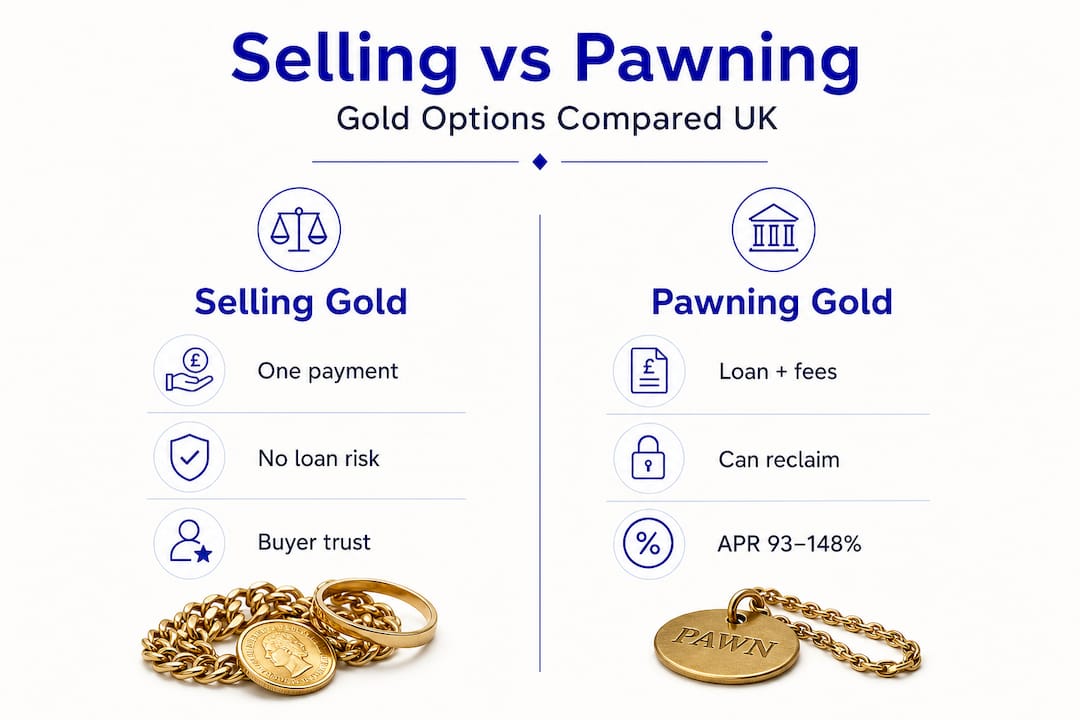
The APR rates of 93-148% are the number that most people gloss over. They shouldn’t. On a £500 loan at 148% APR over six months, you could be repaying well over £600 just to reclaim an item you already own. That’s a significant cost for temporary liquidity.
Here’s when each option actually makes sense:
Pawning makes sense when:
- You need short-term cash but expect to receive money soon (a tax rebate, a bonus, a sale completing)
- The gold has high sentimental value and you’re confident you can repay
- You understand the full cost of the loan and have a clear repayment plan
Selling makes sense when:
- You don’t want or need the gold back
- You want a clean, simple transaction with no ongoing obligations
- The sentimental value is low and you want the best possible cash return now
Our selling vs pawning comparison breaks down real-world scenarios in more detail. And if you’re still uncertain about where to even begin the selling process, the UK jewellery selling guide is worth a read before you make any decisions.
How to make your gold decision: practical steps and tips
Understanding the theory is one thing. Actually deciding what to do with your gold is another. Here’s a practical step-by-step process to help you work through it without second-guessing yourself.
-
Establish your urgency. Do you need cash today, or can you take a week to research properly? Urgency often pushes people towards rushed decisions and poor prices. If you have even a few days, use them.
-
Ask yourself honestly: do I want this gold back? Be real with yourself here. If the answer is yes, pawning might be appropriate. If you’re indifferent, selling is almost certainly the better financial decision.
-
Calculate the true cost of pawning. Get the APR, work out the monthly interest, and calculate what you’d actually pay to reclaim your gold at the end of the term. The best price gold tips page includes useful guidance on benchmarking value before you approach any buyer or pawnbroker.
-
Check the current gold spot price. Gold is traded globally by weight and purity. Before anyone assesses your gold, know roughly what it’s worth per gram. This is freely available online and takes about two minutes to find. Knowledge is your best negotiating tool.
-
Verify FCA authorisation. Whether you’re selling or pawning, check that whoever you’re dealing with is properly authorised. The FCA register is publicly searchable. This step takes sixty seconds and could save you significant grief.
-
Compare at least three offers. We’ve said it before and we’ll say it again. Three quotes minimum. Every time. The variation between offers for the same piece of gold can be startling.
-
Read the fine print before signing anything. If you’re pawning, understand exactly what happens if you miss a repayment. Know the notice period. Know the process. Don’t sign anything you haven’t fully understood.
Pitfalls to avoid:
- Accepting the first offer out of convenience or nervousness
- Ignoring hidden fees in pawn agreements (storage charges, insurance fees, admin costs)
- Using unregulated buyers or pawnbrokers operating outside the FCA framework
- Confusing “assessed value” with “what you’ll receive.” There is always a gap between the two.
Pro Tip: High confidence in repayment is genuinely the deciding factor for pawning. If there’s any real doubt about your ability to repay on time, selling is the safer financial choice every single time.
Our perspective: why most UK gold owners get it wrong (and how to avoid costly mistakes)
Here’s the honest truth, after working with hundreds of UK gold clients over more than two decades. Most people who come to us have already made one expensive mistake before they arrive.
They’ve either sold gold for a fraction of its worth because they walked into the first shop they found, or they’ve pawned gold thinking it was a cheap, harmless short-term solution and then found themselves unable to repay. In both cases, the loss was avoidable.
The biggest misconception we see? People dramatically underestimate how expensive pawning genuinely is. That 93% to 148% APR figure is not a scare tactic. It’s real. And when life gets complicated (which it often does), suddenly a six-month loan becomes impossible to repay, the notice period passes, and a piece of jewellery that meant something is gone. Not sold by you, on your terms. Just gone.
The second mistake is choosing speed over scrutiny. We completely understand the appeal. You need cash, you’re stressed, and the process feels overwhelming. But spending thirty minutes on research and comparison can genuinely add hundreds of pounds to your return.
The third mistake is failing to check who you’re actually dealing with. FCA authorisation exists for good reason. Unregulated buyers and pawnbrokers have no accountability. There’s no ombudsman to complain to, no notice period obligations, no proper credit agreements. If something goes wrong, you have very little recourse.
Our trusted pawn market guide covers exactly how to identify reputable services and avoid the ones that will leave you worse off.
The smartest gold clients we see are the ones who arrive prepared. They know the spot price. They’ve got multiple quotes. They’ve asked the right questions. And they understand, clearly and honestly, whether they’re selling or pawning and why. That preparation is the difference between a good outcome and a regrettable one.
Connect with trusted gold services for peace of mind
When you’re ready to move forward, the most important thing is having access to genuinely trustworthy professionals who are transparent about pricing and regulated to protect you.

At Blackwell Jewellers, our trusted pawnbroking service is FCA authorised and built around transparency. You’ll know exactly what your gold is worth, what the loan terms mean in real money, and what your options are at every stage. If you’re leaning towards selling, our extensive collection of second hand jewellery shows you how we value, authenticate, and responsibly handle pre-owned gold pieces. And if your jewellery needs attention before you make any decision, our expert jewellery repairs service can assess and restore pieces so they’re in the best possible condition, whether you keep them or let them go.
Frequently asked questions
How do UK FCA regulations protect gold pawners?
FCA regulations require pawnbrokers to be authorised, provide written credit agreements, and issue formal notice before selling any unredeemed item, ensuring you have fair warning and clear terms throughout the process.
What are the typical costs of pawning gold in the UK?
APR rates typically range from 93% to 148%, making pawning a genuinely expensive option. As a secured short-term loan with monthly interest charges, it only makes financial sense if you’re highly confident you can repay within the agreed term.
Is selling gold in the UK safer than pawning it?
Selling gold is the lower-risk option when you choose a reputable, transparent buyer, because there are no ongoing loan costs, no monthly interest, and no risk of losing your item if circumstances change unexpectedly.
Can I reclaim my gold after pawning in the UK?
Yes, absolutely. You reclaim your gold by repaying your loan plus all accrued interest within the agreed term. However, if you miss the deadline and the notice period passes, the pawnbroker can legally sell your item to recover the loan amount.
How can I maximise the value when selling gold?
Get at least three independent quotes from FCA-authorised gold buyers, check the live spot price for gold beforehand so you understand the baseline value, and always ask for a clear written breakdown of how any offer has been calculated.