
TL;DR:
- Gold pricing varies significantly depending on location, purity, and market fluctuations, with the spot rate serving as a global benchmark. Dealers consider additional costs and margins, meaning sellers typically receive less than the raw metal value, which fluctuates daily based on various economic factors. Proper testing, hallmarking, and market knowledge are essential to accurately assess and maximize the value of gold jewelry.
Think all gold is valued the same, regardless of where you sell it or who’s buying? It really isn’t. The live gold spot price in the UK sits at around £113.19 per gram for pure 24ct gold, but what you actually pocket when you walk out of a jeweller’s shop can be a very different story. Whether you’ve got a drawer full of old chains, a ring that’s seen better days, or you’re simply trying to work out if that inherited bracelet is worth anything, this guide will walk you through exactly how gold pricing works in the UK, what your carats actually mean in pounds, and how to make sure you’re not leaving money on the table.
Table of Contents
- Understanding the gold price per gram in the UK
- Gold purity explained: Why carats matter
- How to value your gold jewellery for sale or insurance
- Where to get the best price per gram when selling gold
- Why the real price you get for gold is almost never the headline rate
- Find great value with trusted jewellery services
- Frequently asked questions
Key Takeaways
| Point | Details |
|---|---|
| Live price awareness | Keep track of the live gold price per gram to make informed decisions when buying or selling. |
| Purity impacts value | The carat rating of your gold significantly determines its value per gram. |
| Market options differ | Where and how you sell gold jewellery affects how much you receive per gram. |
| Actual payout varies | You are unlikely to receive the spot price due to dealer margins and fees. |
Understanding the gold price per gram in the UK
Let’s start with the basics. The spot price is the global benchmark price for one troy ounce of pure gold, traded in real time on commodity markets. Everything else, what a jeweller quotes you, what a pawnbroker offers, what an online buyer advertises, is derived from that number.
Right now, the UK gold spot price is approximately £113.19 per gram for 24 carat (pure) gold. That’s not a fixed number though. It shifts constantly, driven by currency fluctuations, geopolitical events, inflation data, and investor sentiment. It can move several pounds in a single day.
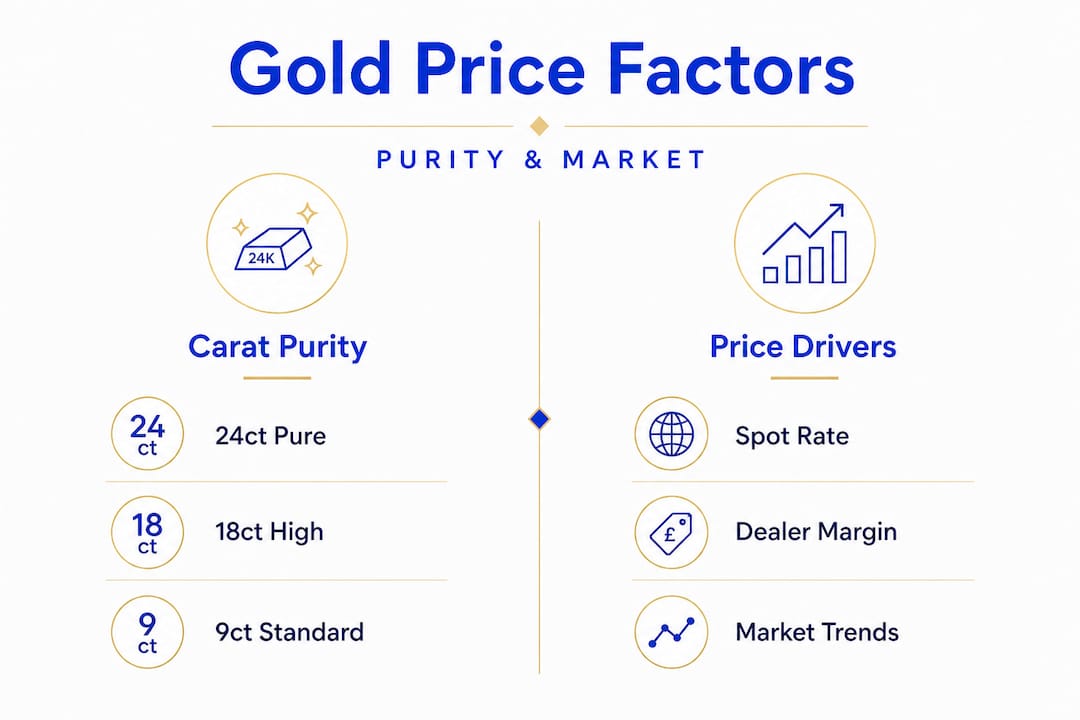
Here’s a quick snapshot of approximate gold prices per gram by carat at that spot rate:
| Carat | Gold purity | Approx. price per gram (GBP) |
|---|---|---|
| 24ct | 99.9% | £113.19 |
| 18ct | 75.0% | £84.89 |
| 14ct | 58.5% | £66.22 |
| 9ct | 37.5% | £42.45 |
These figures are based on the live spot rate and are approximate. They change daily, sometimes hourly.
So why does retail differ from spot? Quite simply, because no one sells gold at cost. Dealers factor in:
- Testing and authentication costs (verifying what they’re buying)
- Refining fees (converting jewellery back into raw gold)
- Operating margins (staff, premises, insurance)
- Market risk (prices could drop before they resell)
That’s not them being sneaky. It’s just business. But knowing this means you go in with realistic expectations rather than shock and disappointment.
And what moves the spot price around? Big factors include US dollar strength (gold is priced in dollars globally, so sterling exchange rates matter enormously), central bank activity, global conflict and uncertainty, and supply from major gold-producing countries like China, Russia, and Australia. When things feel uncertain in the world, gold tends to rise. When markets are calm and confident, it often dips.
If you want to understand more about how this translates to real-world jewellery valuation, our UK gold valuation guide breaks it down in detail.
Pro Tip: Bookmark a live gold price tracker and check it at the same time each week. You’ll quickly get a feel for whether prices are trending up or down, which helps you time a sale or purchase more intelligently.
Gold purity explained: Why carats matter
Here’s where a lot of people get caught out. They hear “gold” and assume all gold jewellery is equally valuable. It’s not. Not even close.
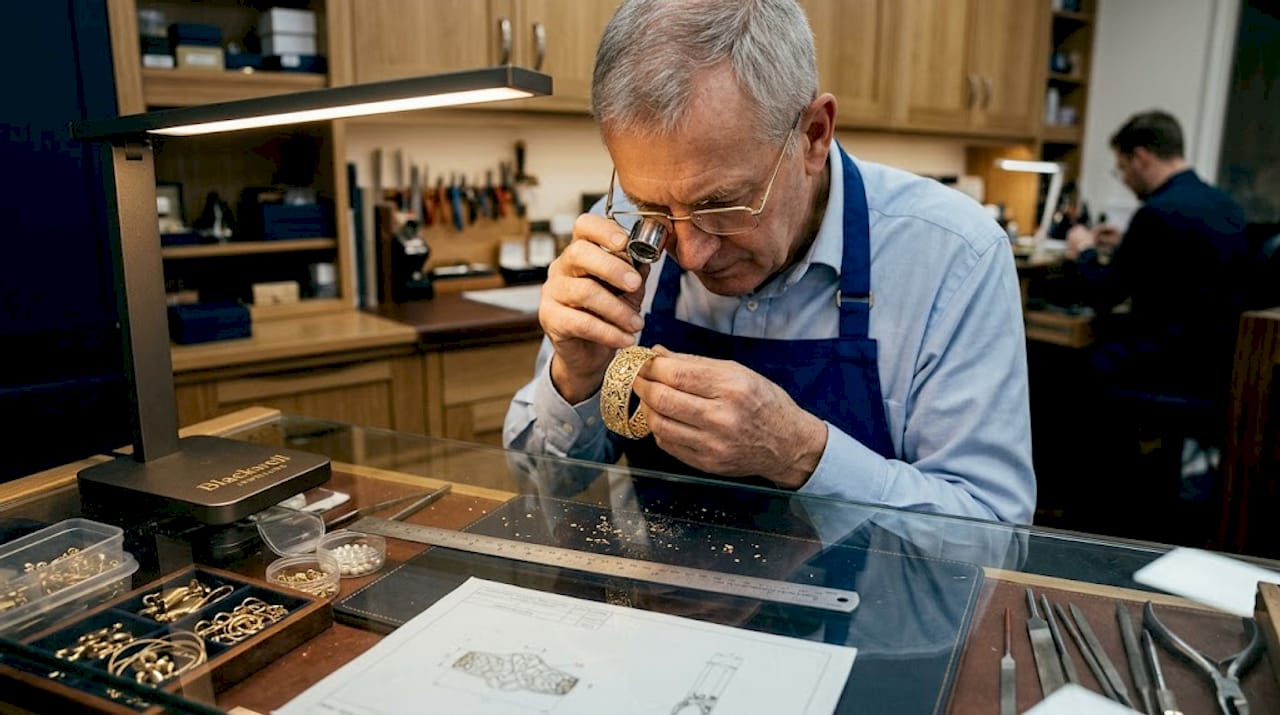
The carat (often written as “ct” in the UK) tells you how much of the metal is actually gold versus other alloys like copper, silver, or zinc. Pure gold is 24ct. Everything else is a mixture.
Here’s how it breaks down:
| Carat | Pure gold content | Typical use | Approx. price per gram |
|---|---|---|---|
| 24ct | 99.9% | Bullion, coins, investment | £113.19 |
| 18ct | 75.0% | Fine jewellery, engagement rings | £84.89 |
| 14ct | 58.5% | Common in US, some UK pieces | £66.22 |
| 9ct | 37.5% | Everyday UK jewellery | £42.45 |
Based on the current UK spot price of £113.19 per gram for 24ct gold.
Now, how do you actually check what carat your jewellery is? In the UK, hallmarking is compulsory for gold items over a certain weight sold by trade sellers. Look for these stamps:
- Find a magnifying glass. Hallmarks are tiny and usually stamped in an inconspicuous spot, inside a ring band, on a bracelet clasp, or near the fastening on a necklace.
- Look for a three or four-digit number. Common ones are 375 (9ct), 585 (14ct), 750 (18ct), and 999 (24ct/pure gold).
- Look for the assay office mark. UK assay offices in London, Birmingham, Edinburgh, and Sheffield each have a distinctive symbol.
- Check for the date letter and sponsor’s mark (the maker’s initials). These confirm authenticity and provenance.
If there’s no hallmark, that doesn’t automatically mean it’s worthless. Older pieces, particularly antique jewellery, may predate modern hallmarking requirements. A professional jeweller can perform an acid test or XRF (X-ray fluorescence) test to confirm purity.
And if you want to know the real worth of your gold based on purity and weight, that link will walk you through the calculation clearly.
Pro Tip: Don’t confuse gold-plated jewellery with solid gold. Gold-plated pieces have a thin layer of gold over a base metal (usually brass or copper). The gold content is negligible and worth almost nothing in melt value. If a piece feels very lightweight and the colour is rubbing off at the edges, it’s likely plated.
How to value your gold jewellery for sale or insurance
Right. You’ve got a rough idea of your gold’s purity. Now let’s actually work out what it’s worth.
Here’s the simple step-by-step process:
- Weigh your piece. Use a precise digital scale (accurate to 0.1g or better). Kitchen scales won’t cut it here. You need jeweller-grade accuracy.
- Identify the carat. Use the hallmark guide above. If unsure, get it tested professionally.
- Check the live spot price. Use a reliable source like Chards or the London Bullion Market Association (LBMA) for a current per-gram figure.
- Calculate the pure gold content. Multiply the weight by the purity percentage. A 10g 9ct gold ring has 3.75g of pure gold (10 x 37.5%).
- Multiply by the spot price. 3.75g x £113.19 = approximately £424.46 in pure gold value.
- Apply a realistic margin. Dealers typically offer 70 to 90% of melt value for scrap gold, sometimes less for heavily worn pieces.
That final figure is your approximate melt value, which is the floor, not the ceiling, of what your jewellery could be worth. Designer pieces, antique jewellery, or items in excellent condition may command significantly more.
“The melt value is just the starting point. A beautiful Art Deco brooch in perfect condition isn’t worth the same as a twisted, broken chain, even if both weigh exactly the same.”
For insurance purposes, you’ll want to gather:
- A professional valuation certificate (updated every 3 to 5 years, as gold prices shift)
- Photographs of the piece from multiple angles
- Any receipts, provenance documents, or original certificates
- Details of the hallmark, maker, and assay office
If you’d like to value your gold at home before visiting a jeweller, our guide covers the tools and process in detail. And if you’re specifically looking to sell, understanding how to get the best price for your gold is equally important.
Remember: condition and provenance matter enormously. A gold chain with a broken clasp is still gold, but you’ll get less for it. Meanwhile, a hallmarked antique ring from a recognised maker might sell for far above its melt value to the right collector.
Where to get the best price per gram when selling gold
Knowing your jewellery’s value is one thing. Getting that value is another matter entirely.
Here are your main options in the UK, along with an honest look at each:
- High street jewellers. Reputable, transparent, and accountable. They’ll test your gold properly and give you a fair price. The trade-off is they’re not always offering the very highest rate, because they have overheads and quality standards to maintain. But you get peace of mind and a paper trail.
- Online gold buyers. Companies like Gold Fellows or Hatton Garden Metals operate nationally and often advertise competitive rates. The downside? You post your jewellery off, wait for an offer, and then decide. If you decline, they post it back, but that process can take time and feels nerve-wracking.
- Pawnbrokers. Often misunderstood, pawnbrokers offer either a loan against your gold (you get it back when you repay) or an outright purchase. Rates can vary widely. Use a reputable, regulated broker.
- Auction houses. Excellent for high-value or unique pieces where collector demand may push prices above melt value. Not ideal for standard jewellery due to fees and slower payment timelines.
- Cash-for-gold kiosks. Generally the worst option. Margins are high, testing can be rushed, and the transparency is often questionable.
For a thorough breakdown of your options, our guide on where to sell gold in the UK covers the full spectrum. And if you specifically want to understand scrap gold prices UK, that’s worth a read too.
A quick comparison of typical payout rates:
- High street jewellers: 75 to 90% of melt value
- Online buyers: 70 to 88% of melt value (varies significantly by company)
- Pawnbrokers: 60 to 85% of melt value
- Cash kiosks: 40 to 65% of melt value (avoid these if at all possible)
Pro Tip: Sell when the gold spot price is trending upward, not when it’s just peaked and starting to fall. Even a £5 to £10 per gram difference can add up noticeably on a 20g piece.
Why the real price you get for gold is almost never the headline rate
Let’s be completely honest with you here, because frankly not enough people in this industry are.
That £113.19 per gram figure? You’re not getting that. Almost no private seller does. And understanding why is the difference between feeling ripped off and feeling genuinely informed.
The spot price is a wholesale benchmark for large-volume transactions between institutional buyers. It’s the price at which banks, refiners, and ETF managers trade gold. It is not the rate your local jeweller pays for your nana’s bracelet.
Between spot price and what lands in your bank account, you’ve got:
- Dealer margin (they need to make money)
- Testing and verification costs (acid tests, XRF equipment isn’t free)
- Refining costs (turning jewellery into pure tradeable gold costs money)
- Local market demand (a dealer in a small town may pay less than one in London)
- Condition premium or penalty (worn, broken, or mixed-metal pieces get less)
This isn’t a conspiracy. It’s just commerce. The good news is that knowing this puts you in control. You can shop around, get multiple quotes, and understand what’s reasonable versus what’s exploitative.
We’d strongly recommend reading our thoughts on selling vs pawning jewellery before making any decision, especially if you’re not certain you want to part with a piece permanently. Pawning gives you a window to reclaim it, which can be genuinely valuable when you’re selling during a moment of financial pressure rather than genuine intent.
The bottom line: information is your best negotiating tool. A seller who knows what their 9ct gold weighs, what the spot price is today, and what a reasonable dealer margin looks like, will always walk away with more than someone who walks in blind.
Find great value with trusted jewellery services
If you’ve read this far, you’re clearly serious about getting the best value from your gold, and that’s exactly the kind of customer we love working with at Blackwell Jewellers.

Whether you’re selling gold, buying pre-owned jewellery, or looking for expert repairs, our family-run business has been helping UK customers navigate the jewellery market for over 20 years. Explore our authenticated pre-owned jewellery collection for gold pieces that have been rigorously inspected, hallmarked, and restored by our in-house team. Need something fixed or resized? Our jewellery repair services are handled by skilled craftspeople on-site. And if you need fast access to cash without permanently parting with your jewellery, find out how our pawnbroking options work. Transparent, professional, and genuinely helpful.
Frequently asked questions
How often does the gold price per gram change in the UK?
The gold price updates live every few seconds, tracking global commodity market movements in real time, so it can shift meaningfully across a single trading day.
Is the spot price what I will actually get when I sell my gold jewellery?
No, the spot price is a benchmark used by institutional traders; private sellers receive less because dealers subtract testing, refining, and operating costs before making an offer.
What is the current gold price per gram for 9ct and 18ct gold in the UK?
Using the current spot rate of £113.19 per gram for 24ct gold, 9ct gold is approximately £42.45 per gram and 18ct is approximately £84.89 per gram, reflecting their respective purity levels.
How can I check what gold my jewellery is made of?
Look for UK hallmark stamps on your piece: 375 indicates 9ct gold, 585 is 14ct, and 750 confirms 18ct, all of which are standard purity markers used across UK jewellery.
Are pre-owned gold jewellery prices always based on metal value alone?
No, pre-owned pieces can be valued considerably higher than their melt weight suggests when factors like craftsmanship, designer provenance, rarity, and condition are taken into account by specialist buyers.
Recommended
- What’s my gold worth per gram? A clear UK valuation guide 2026 – blackwellonline
- How to value your gold in the UK: get the best price – blackwellonline
- Compare the best gold price UK today: Smart buying guide – Blackwell Jewellers
- How to Value Your Gold at Home (UK Edition) – blackwellonline
- Gold Trading Software: Boosting Automated Profits