

TL;DR:
- UK scrap gold prices range from 60% to 95% of the live spot price, depending on buyer and purity.
- Valuing gold at home with accurate weighing and online tools helps negotiate better deals.
- Comparing multiple reputable buyers and checking their transparency ensures you get the best payout.
Most people selling scrap gold in the UK walk away with far less than they expected. The gap between the daily spot price and what a buyer actually pays you can be as wide as 40%, yet many sellers never question the first offer they receive. Knowing how scrap gold prices are calculated, which buyers offer the fairest rates, and how to value your own items before you sell can make a real difference to your final payout. This guide walks you through everything, from understanding the spot price to negotiating confidently, so you can sell your gold with clarity and get the best deal possible.
Table of Contents
- How are scrap gold prices set in the UK?
- Who pays what? Comparing buyers and payouts
- How to value your scrap gold at home
- Getting the best price: strategy and negotiation
- What most sellers miss about scrap gold prices
- Sell scrap gold with confidence at Blackwell Jewellers
- Frequently asked questions
Key Takeaways
| Point | Details |
|---|---|
| Understand true payout rates | UK buyers typically pay 60% to 95% of the gold spot price, depending on purity and reputation. |
| Prioritise transparency | Choose buyers with live rate publication and high independent reviews for peace of mind. |
| Estimate gold value yourself | You can use scales, hallmarks, and online calculators to get a realistic price before selling. |
| Compare and negotiate | Always compare several professional quotes and be prepared to negotiate politely. |
How are scrap gold prices set in the UK?
The starting point for any scrap gold transaction is the spot price, which is the live market price for one gram of pure 24-carat gold. It changes throughout every trading day, driven by global supply and demand, currency movements, and investor sentiment. You can check it on financial data sites or through reputable bullion dealers at any time.
Here is the important part: you will never receive the full spot price when selling scrap gold. Buyers need to cover their costs for refining, testing, insurance, and profit. What you actually receive is a percentage of the spot price, and that percentage varies enormously depending on who you sell to.
Gold purity plays a major role in determining your payout. UK gold is hallmarked in carats, with common purities being:
- 24ct (99.9% pure gold)
- 18ct (75% pure gold)
- 14ct (58.5% pure gold)
- 9ct (37.5% pure gold)
The higher the carat, the more gold content per gram, and the higher the price per gram you should expect. Understanding your gold value per gram before you approach any buyer gives you a baseline to measure every offer against.
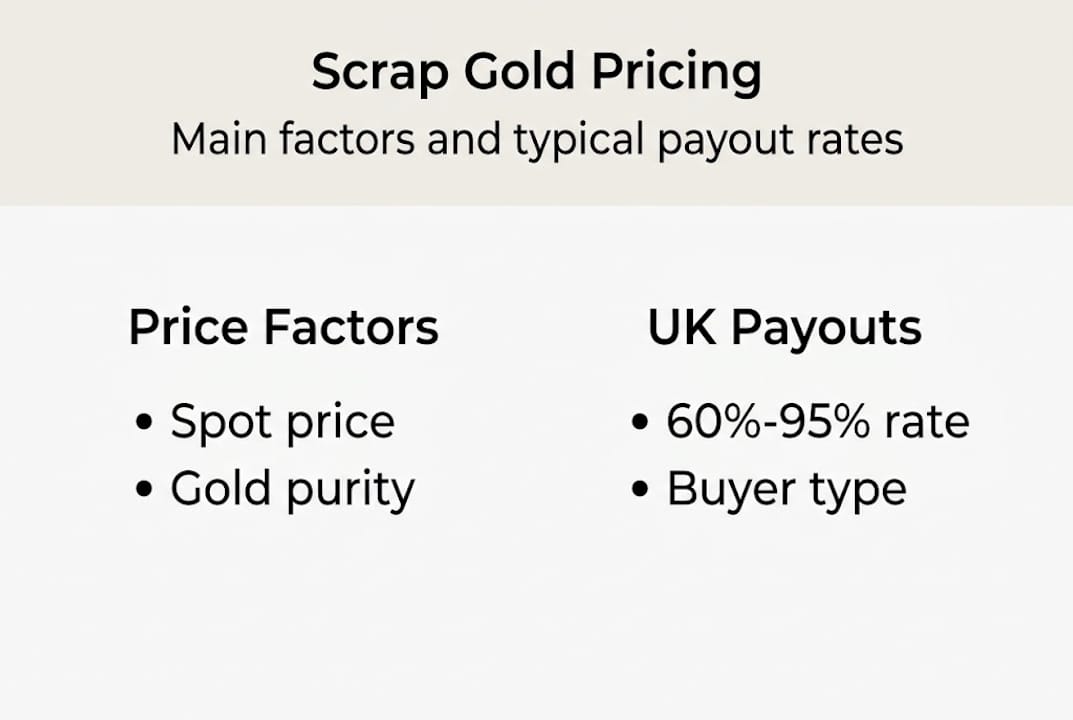
The typical payout range across UK buyers sits between 60% and 95% of spot, which is a wide band. At the lower end, you might find high-street cash-for-gold shops or postal services with opaque pricing. At the upper end, established bullion dealers and specialist gold buyers publish live rates and compete openly for your business.
| Gold purity | Spot price per gram (approx.) | Typical payout at 91% |
|---|---|---|
| 24ct | £65.00 | £59.15 |
| 18ct | £48.75 | £44.36 |
| 14ct | £38.03 | £34.61 |
| 9ct | £40.84 | ~£37.38/g |
These figures are approximate and shift daily, but they illustrate the real-world difference between purity levels. A thorough approach to valuing your gold before any sale means you can spot a low offer immediately rather than accepting it out of uncertainty.
Who pays what? Comparing buyers and payouts
Not all gold buyers are equal, and the difference between a good and a poor buyer is not just about the headline percentage. Transparency, speed of payment, customer service, and clear terms all matter when you are handing over valuable items.
The most competitive buyers in the UK tend to be online bullion dealers and specialist gold purchasing platforms. Established buyers such as BullionByPost pay up to 95% of spot, while Gold Traders UK pays around 91% for 9ct gold. These firms publish live rates on their websites, so you always know what to expect before you post anything.
| Buyer | Payout (approx.) | Trustpilot score | Live rates published |
|---|---|---|---|
| BullionByPost | Up to 95% spot | 4.7/5 | Yes |
| Gold Traders UK | ~91% spot | 4.8/5 | Yes |
| CashForYourGold | ~85% spot | 4.9/5 | Yes |
| GoldXchange | ~80% spot | 4.8/5 | Yes |
| High-street cash shops | 50-70% spot | Varies | Rarely |
When choosing where to sell gold, look beyond the percentage alone. A buyer offering 95% with poor reviews and slow payment may cost you more in stress and time than one offering 91% with an outstanding track record.
Here is what to check before committing to any buyer:
- Live rate transparency: Can you see exactly what they will pay before you send your gold?
- Trustpilot or Google reviews: Look for consistent positive feedback, not just a handful of five-star ratings.
- Payment speed: Reputable buyers typically pay within 24 to 48 hours of receiving your items.
- Free returns policy: If you decline their offer, do they return your gold at no cost?
- Insurance during transit: Postal buyers should provide fully insured, tracked postage.
Use a UK gold calculator to generate a benchmark figure before contacting any buyer. This gives you a number to compare all incoming offers against, which immediately reveals who is being fair and who is not. For broader guidance on best jewellery selling tips, understanding the full landscape of buyers is the first step.
Pro Tip: Always get at least three quotes from different buyers before accepting any offer. The spread between the lowest and highest quote is often surprising, and having competing offers gives you genuine negotiating power.
How to value your scrap gold at home
Before you approach any buyer, spending 20 minutes valuing your gold at home puts you in a far stronger position. You do not need specialist equipment. A basic kitchen scale, a magnifier, and a reliable internet connection are enough to get a solid estimate.
Here is a straightforward process to follow:
- Separate your items by hallmark. Group pieces by carat (9ct, 14ct, 18ct, 24ct). The hallmark is usually stamped inside rings or on clasps. Use a magnifier if needed.
- Weigh each group in grams. Kitchen scales accurate to 0.1g work well. Remove any stones, as buyers will deduct for non-gold elements.
- Check the live spot price. Use a bullion site or financial data feed for today’s figure.
- Input your details into an online calculator. Tools like ScrapGoldCalculator will give you an estimated value based on weight, purity, and current rates.
- Apply a realistic payout percentage. Multiply your estimated gold value by 85% to 91% to reflect what a reputable buyer is likely to offer.
Bear in mind that online calculators provide pre-sale estimates only. Actual offers depend on the buyer’s own testing, which may reveal slight discrepancies in weight or purity. This is normal, but it is why getting multiple quotes matters.
For a more detailed walkthrough, our guide on how to value gold at home covers common pitfalls and how to read hallmarks accurately.
Pro Tip: Remove any gemstones from settings before weighing if possible, and clean your pieces to remove debris. Even a small amount of dirt or residue can affect the reading on sensitive scales.
“The more accurately you can estimate your gold’s value before selling, the less likely you are to accept an offer that undervalues it.”
Always note down your calculations. Having a written record of your estimated weight, purity, and value makes it much easier to challenge a low offer or ask a buyer to explain their figure. Our gold selling tips cover this in more detail.
Getting the best price: strategy and negotiation
Valuing your gold at home is preparation. Getting the best price is about strategy. Many sellers treat the first offer as final, which is rarely the right approach with reputable buyers.
Start by collecting 3 or more quotes from different buyers. Use your home valuation as your baseline. Any offer significantly below your estimate deserves a question, not an immediate acceptance. Reputable buyers will explain their figure and, in many cases, will improve their offer if you can demonstrate a competing quote.
Here is how to approach the process strategically:
- Use your best quote as leverage. Contact your second-choice buyer and ask if they can match or beat it. Many will.
- Read the full terms and conditions. Some buyers advertise high percentages but apply deductions for postage, insurance, or processing fees that reduce your actual payout.
- Check payment timelines. Delayed payment is a red flag. Reputable buyers pay promptly once they have verified your gold.
- Avoid buyers making unrealistic promises. If someone claims to pay 100% of spot or significantly above market rates, treat it with scepticism.
- Consider timing. Gold prices fluctuate daily. Selling during a period of high spot prices naturally increases your return.
For a full breakdown of the process, our guide on selling gold for highest value covers every stage from preparation to payment. If you are weighing up different selling methods, our article on the best way to sell gold jewellery compares postal buyers, local dealers, and auction options side by side.
Pro Tip: If a buyer declines to negotiate or becomes evasive when you mention a competing offer, that tells you something important about how they operate. A confident, reputable buyer will engage openly with your questions.
What most sellers miss about scrap gold prices
After more than 20 years working with gold sellers across Kent and beyond, we have noticed a consistent pattern: sellers who focus purely on the headline price per gram often end up less satisfied than those who prioritise the full experience.
The difference between 91% and 95% of spot on a 10-gram 9ct piece is roughly £1.83. That is not nothing, but it is also not worth sacrificing clear documentation, reliable payment, or a buyer who answers the phone when something goes wrong.
What genuinely matters is whether the buyer provides written confirmation of their offer, a transparent breakdown of how they calculated it, and a clear process for returning your items if you decline. These things protect you far more than an extra percentage point ever will.
We always recommend sellers in Kent consider selling gold locally, where face-to-face accountability adds a layer of security that no postal service can replicate. You can ask questions, see the testing process, and leave with payment in hand. That peace of mind has a real value that rarely appears in a comparison table.
Sell scrap gold with confidence at Blackwell Jewellers
If you are ready to sell your scrap gold and want a transparent, straightforward experience from a business with over 20 years of trusted trading, Blackwell Jewellers is here to help. Our expert team across Kent offers fair evaluations, honest pricing, and the kind of personal service that makes the whole process feel simple rather than stressful.

Beyond scrap gold, we also offer a wide range of second-hand jewellery that has been rigorously inspected, hallmarked, and restored by our in-house jewellers. Whether you are selling, buying, or looking for something truly unique through our bespoke jewellery services, we bring the same commitment to quality and transparency to every transaction. Visit us in Maidstone, Gravesend, or Bexleyheath, or explore our full range online.
Frequently asked questions
How much is scrap gold worth per gram in the UK?
Scrap gold typically sells for 60% to 95% of the spot price, depending on the buyer and gold purity. For 9ct gold, reputable buyers such as Gold Traders UK pay around 91% of spot, which works out at approximately £37.38 per gram.
What is the safest way to sell scrap gold in the UK?
Choose buyers who publish live rates, hold high Trustpilot ratings, and provide clear written terms and documentation. Face-to-face transactions with established local jewellers add an extra layer of security.
How do I check if a scrap gold offer is fair?
Use an online gold calculator for a baseline estimate, then compare at least three quotes and check each offer as a percentage of the current spot price. Any offer below 80% of spot from a reputable buyer warrants scrutiny.
Can I value gold at home before selling?
Yes. Separate your items by hallmark, weigh them in grams using kitchen scales, and enter the details into a UK gold calculator alongside the live spot price for a reliable pre-sale estimate.