

TL;DR:
- Sending a ring for repair requires thorough pre-shipment inspection, proper packaging, and correct insurance coverage. Shipping with signed-for delivery, documentation, and active tracking helps prevent loss and damage disputes. Following these steps ensures safe transit, proper repairs, and clear communication with the jeweller.
Sending a ring for repair is defined as the process of preparing, documenting, and securely shipping a piece of jewellery to a professional workshop for restoration or structural work. Get it right and your ring arrives safely, gets fixed properly, and comes back to you in better shape than it left. Get it wrong and you are dealing with lost parcels, insurance headaches, and a jeweller who has no idea what condition the ring was in when it arrived. This guide covers every stage of the ring repair process, from initial inspection and packing to courier selection, insurance, and what to expect once your ring is in the workshop’s hands.
What you need before sending your ring for repair
Preparation is the part most people skip. That is a mistake.
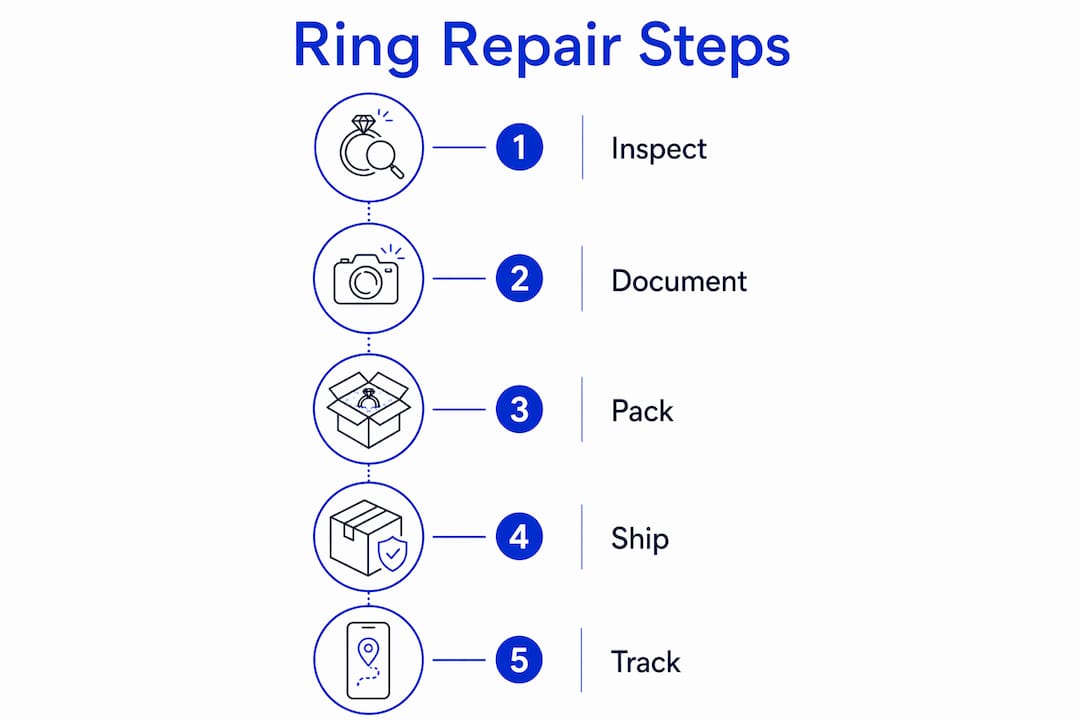
Before you even think about bubble wrap, you need to inspect your ring carefully under good natural light or a bright lamp. Note every existing scratch, worn prong, loose stone, or surface mark. Jewellery repair workshops require detailed condition reports and customer instructions, and the best way to provide them is with a thorough documented inspection before shipping. This protects you and the jeweller.
Materials you will need
Gather these before you start packing:
- A ring box with a foam insert (the foam grips the band and stops movement)
- Anti-tarnish strips or tissue to wrap the ring
- A rigid outer box or padded mailer
- Void fill such as crumpled paper or foam peanuts
- Tamper-evident tape
- A printed repair request form with your name, contact details, and clear repair instructions
- Photographs or a short video of the ring’s condition
Documentation checklist
| Document | Why you need it |
|---|---|
| Repair request form | Tells the jeweller exactly what work is needed |
| Proof of purchase or appraisal | Establishes value for insurance purposes |
| Photographs of the ring | Visual record of pre-existing condition |
| Video of packing process | Key evidence if a damage dispute arises |
| Tracking receipt from courier | Proof of postage and delivery confirmation |
One thing most people do not think about until it is too late: insurance. Standard courier policies almost universally exclude jewellery and precious metals without a specific declaration. That means your ring is not automatically covered just because you paid for postage. Check this before you hand the parcel over.
How to pack your ring securely for shipping
This is where the real work happens. Follow these steps in order and you will not regret it.
-
Inspect and photograph the ring. Use good lighting. Take photos from multiple angles, including close-ups of any damage, stones, and hallmarks. These images are your baseline record.
-
Record a video of the packing process. This sounds over the top, but it is not. Recording yourself packing the ring, showing its condition and each layer of wrapping, is the most effective way to avoid costly false damage claims. If a dispute arises later, this video is your best evidence.
-
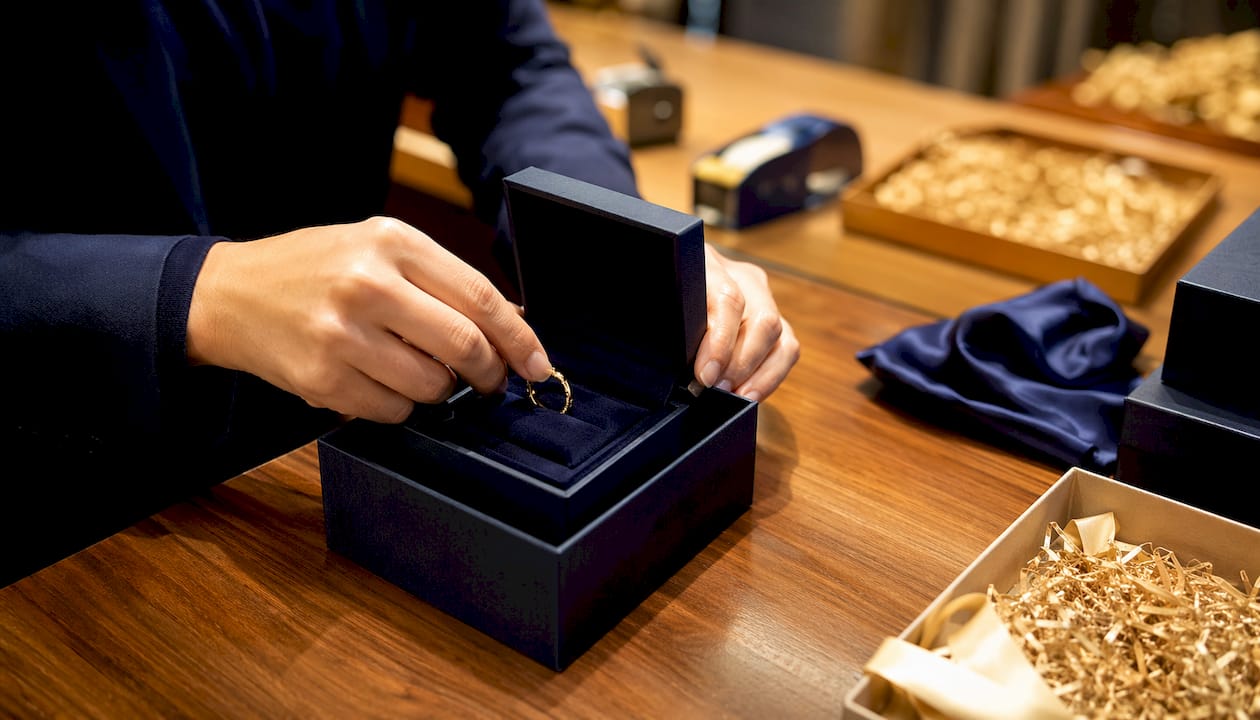
Wrap the ring in anti-tarnish tissue or cloth. Never use standard tissue paper alone for gold or silver pieces. Anti-tarnish materials prevent surface oxidisation during transit, especially if the parcel sits in a depot for a day or two.
-
Secure the ring in a foam-cushioned ring box. A ring should not move inside its box. A foam insert grips the band firmly and prevents scratches caused by the ring rattling around. Do the shake test: if you can hear or feel movement, add more foam or tissue until the ring is completely still.
-
Place the ring box inside a rigid outer box with void fill. Padded rigid mailers or small cardboard boxes with void fill are the right choice here. The void fill stops the inner box from shifting during transit. For particularly fragile rings or those with delicate stones, double-boxing adds an important extra layer of protection.
-
Seal with tamper-evident tape and label clearly. Write the delivery address and your return address on the outer box. Do not write “jewellery” or “ring” anywhere on the outside. Advertising the contents invites theft.
-
Photograph the sealed package. Take a final photo of the fully sealed parcel before you leave the house. Keep it with your other records.
Pro Tip: If your ring has a chain or pendant attached, thread the chain through a folded piece of card or a paper straw before packing. This completely prevents tangling during transit and saves you a frustrating untangling session when the ring arrives back.
How to choose the right courier and insurance
Not all couriers treat parcels the same way, and the difference matters when you are shipping something valuable.
The single most important thing to know: standard “Goods in Transit” policies almost universally exclude jewellery and precious metals. That exclusion applies whether you are using a national postal service or a private courier. You need to declare the item specifically and arrange appropriate cover.
Here is what to look for when choosing your shipping service:
- Signed-for delivery with tracking. Signature confirmation means the parcel cannot be left unattended. For any ring worth more than a few hundred pounds, this is non-negotiable.
- Declared value cover. Ask the courier explicitly whether jewellery is covered under their declared value scheme. Many exclude it. If they do, look at specialist parcel insurance providers instead.
- Special handling options. Some couriers offer fragile or high-value handling. It costs a little more and is worth every penny.
Hand-delivering your parcel to the courier counter and obtaining a receipt with a tracking number is the single best way to protect against loss or theft. Drop boxes offer no accountability. If your ring goes missing from a drop box, you have almost no recourse. Walk it in, get the receipt, and keep it safe.
If a claim does become necessary, most insurers require notification within 7 days of the incident. You will also need photographs, proof of value, and in the case of theft, a police report. This is exactly why the documentation steps above matter so much. Without them, a claim is very difficult to pursue.
For rings with significant value, consider a specialist jewellery insurance policy that covers transit specifically. These policies exist precisely because standard courier cover falls short for precious items.
What happens after you send your ring?
Once the parcel is on its way, your job is not quite done.
Track the shipment actively. Use the tracking number from your courier receipt to monitor progress. Most services update in real time. If the parcel stalls or shows an unexpected status, contact the courier immediately rather than waiting.
Confirm receipt with the jeweller. Postal jewellery repairs work best when both sides communicate clearly. Contact the workshop once tracking shows delivery and ask them to confirm the ring has arrived and matches the condition described in your repair request form.
Understand typical repair timelines. Simple repairs such as ring resizing or prong retipping often take a few days to a week. More complex work, such as stone replacement or structural rebuilding, can take two to three weeks. Ask the jeweller for a realistic timeline upfront so you are not chasing them unnecessarily.
Inspect the ring thoroughly on return. When your ring arrives back, do not just glance at it and put it away. Compare it against your pre-shipping photographs. Check the repair work, the surface condition, and the stones. If anything looks different from what was agreed, contact the jeweller straight away with your photographic evidence. A reputable workshop will take this seriously.
Pro Tip: Take a fresh set of photographs of the ring immediately after it returns. This creates a post-repair record and is useful for insurance purposes going forward.
Key takeaways
Sending a ring for repair safely requires thorough documentation, correct packing, declared insurance cover, and signed-for delivery with active tracking throughout the process.
| Point | Details |
|---|---|
| Document before you pack | Photograph and video the ring’s condition before wrapping to protect against disputes. |
| Secure the ring completely | Use a foam-insert ring box so the ring cannot move, then double-box for fragile pieces. |
| Check your insurance | Standard courier policies exclude jewellery; declare the item or arrange specialist cover. |
| Hand-deliver to the courier | Always get a receipt with a tracking number; never use a drop box for valuable items. |
| Inspect on return | Compare the repaired ring against pre-shipping photos and report discrepancies immediately. |
What I have learned from watching people get this wrong
Here is the honest truth: most of the problems people encounter when sending a ring for repair are entirely avoidable. They are not caused by dishonest couriers or careless jewellers. They are caused by customers who skip the preparation stage because it feels like faff.
The video documentation step is the one I feel most strongly about. I have seen disputes where a customer was absolutely certain a stone was chipped during transit, and the jeweller was equally certain it arrived that way. Without video evidence, there is no resolution. With it, the answer is usually obvious within thirty seconds. It takes two minutes to record. Do it every single time.
The other mistake I see constantly is under-insuring. People know their ring is worth £800 but they ship it on a standard service with £50 of cover because they do not want to pay the extra few pounds for declared value. Then something goes wrong and they are furious. The maths here is simple: the cost of proper cover is trivial compared to the value of the ring.
My honest recommendation is to choose a jeweller with a clear, transparent repair by post process. A good workshop will tell you exactly what they need from you, confirm receipt promptly, and keep you informed throughout. If a jeweller is vague about their process before you send anything, that is a signal worth paying attention to.
— James
Ring repairs by post with Blackwelljewellers
Blackwelljewellers has handled postal ring repairs for customers across the UK for over 20 years. The team at their Kent workshops, covering Maidstone, Gravesend, and Bexleyheath, brings genuine in-house expertise to every repair, from simple resizing to complex structural work on gold, silver, and diamond pieces.

Every ring received by post goes through a condition check on arrival, with the customer notified promptly. Blackwelljewellers provides clear repair timelines, transparent pricing, and straightforward communication throughout. If you are ready to send your ring in, visit the jewellery repairs page for full details on the postal repair process and how to get started.
FAQ
Does standard courier insurance cover jewellery?
Standard courier “Goods in Transit” policies almost universally exclude jewellery and precious metals unless the item is specifically declared. Always check with your courier and arrange specialist cover if needed.
How do I stop my ring from getting damaged in the post?
Place the ring in a foam-insert ring box so it cannot move, then pack that box inside a rigid outer box with void fill. A ring that cannot shift inside its packaging will not get scratched during transit.
What documents should I send with my ring for repair?
Include a printed repair request form with your name, contact details, and clear instructions, along with proof of purchase or a recent appraisal. These help the jeweller understand exactly what work is needed and establish the ring’s value.
How long does a postal ring repair usually take?
Simple repairs such as resizing typically take a few days to one week. More involved work such as stone replacement or structural repairs can take two to three weeks. Confirm the timeline with your jeweller before sending.
What should I do if my ring arrives back damaged?
Compare the returned ring against your pre-shipping photographs immediately. If there are discrepancies, contact the jeweller straight away with your photographic and video evidence. Most reputable workshops will address genuine concerns promptly.